|
| From ProCon.or |
When it comes to discussions about issues in education, I would like to think I interact with an educated mind. It is important for me to try to understand different points of view without necessarily adopting them, and I hope that everyone engaged in the discussion will do the same. This was tested last week as I interacted with a Canadian mathematician involved in a group interested in influencing education policy in his country (some of the interaction can be seen here).
The exchange came about because one of his colleagues recently published a commentary focusing on improving math scores in Canada. What to Do about Canada's Declining Test Scores offers three recommendations but I was most interested in the first piece of "advice":
As a rule of thumb, teachers should be encouraged to follow an 80/20 rule, favouring direct instructional techniques over discovery-based instructional techniques.
The rationale provided includes references to multiple studies that support the use of direct instruction. However, the commentary ignores any research that disagrees with the premise that direct instruction is the most effective method of teaching.
In trying to understand the perspective of this group of mathematicians, I got this regarding the use of qualitative research:

 Which brings me back to the question, "Who deserves a seat at the table?" I would say everyone does (although, people who engage in antisocial behavior ought to have it pointed out, and if it continues be shown the door). Extending the metaphor a bit, this does not mean that cooks ought to feel obliged to try to meet every guests' suggestion about the meal or its preparation. While some guests may have more expertise than others in cooking, the cooks are the experts on their own kitchen and their own skills. The cooks need to decide what advice to take. Certainly, this might result in some unhappy guests, but it is likely impossible to satisfy everyone given that the table is open to all.
The same goes for teachers. Too many outside "experts" are telling teachers what ought to be going on in their classroom. Whether the experts are saying discovery-based or direct instruction, teachers ought to remember Hattie's (2012) overall findings:
The remarkable feature of the evidence is that the greatest effects on student learning occur when teachers become learners of their own teaching, and when students become their own teachers. (p. 14)
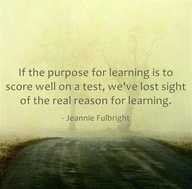
Therefore, I encourage teachers and students to think of themselves as researchers - experimenting to determine what is and isn't working to foster learning and why. It should be noted that numbers on a test do not provide enough data to answer these questions.
The Hattie quote comes early in the text. In regards to the remainder of the book, or any other advice related to classroom instruction, I would suggest teachers heed Aristotle - feel free to entertain the research/recommendations of others but do not accept them if they won't improve the teaching and learning in your classroom.
The Hattie quote comes early in the text. In regards to the remainder of the book, or any other advice related to classroom instruction, I would suggest teachers heed Aristotle - feel free to entertain the research/recommendations of others but do not accept them if they won't improve the teaching and learning in your classroom.