Showing posts with label Final Exam. Show all posts

Tuesday, May 9, 2017

Wanna Play?

Grand Valley's College of Liberal Arts and Sciences has a policy that all courses must meet and have a culminating experience during finals week. Typically, I try to do something other than a traditional exam during these meetings. Most of my students are preservice teachers, and I want to offer them an alternative way to "show what they know" and reflect on the semester; this often entails presentations. But this year we decided to throw a party.

I got the idea when I attended a session at the NCTM 2017 Annual Meeting and Exposition that was led by Kassia Omohundro Wedekind and Mary Beth Dillane - "We are Mathematicians": Building Mathematical Communities Based in Sense Making, Agency, and Joy. During the session, they talked about kids at their school hosting a math party for their peer, teachers, and parents. At the party, the kids shared some of their favorite math activities. I decided this would be a great way to wrap up the semester.

We started the celebration with a popular party game: The Marshmallow Challenge.


Then the pre-service elementary teachers started developing their Math Teaching Vision Boards. I got the idea from this podcast that discusses the role instructional vision has on math teachers' instructional practice.
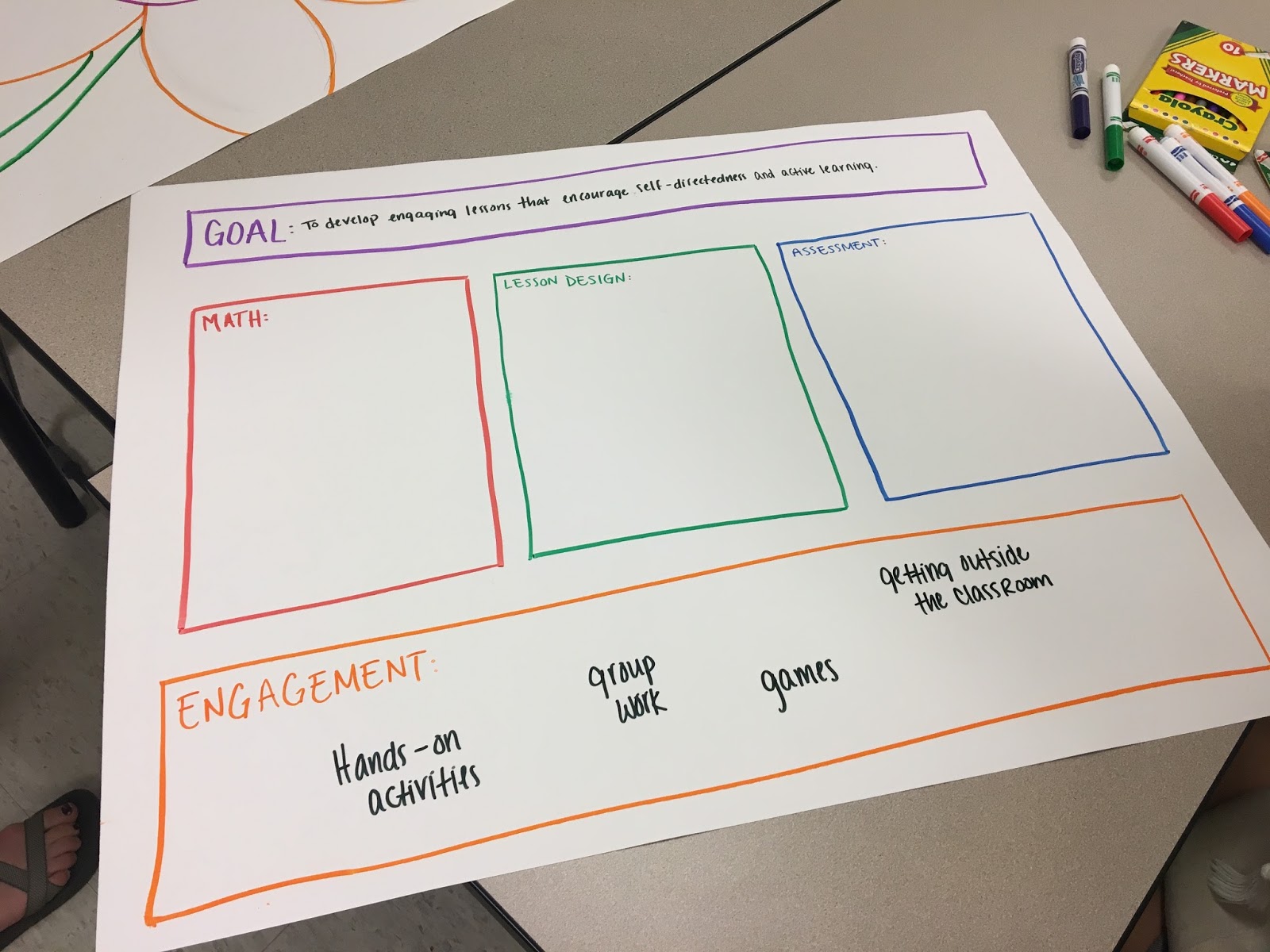

After about 20 minutes, we were ready to share our visions. We didn't have peers, teachers, or parents at our party, so we set up a series of viewing venues arranged by group.


The sharing looked a like this:


At the end of the party, the preservice teachers gave me some feedback. One said, "That was 2 hours of reflection disguised as fun."

Another complained that they didn't get to go to the viewing parties of their table-mates. I told them that was too bad but maybe they could connect with those peers after class to talk about their visions. Then I wondered out loud, "Do you think I did that on purpose?"

Friday, December 13, 2013

Finals! Huh! Yeah! What are they good for?

We just finished finals at Grand Valley. Coincidentally, this week of exams overlapped with the release of the second Hobbit movie; this might explain why these lines (modified from this poem) were going through my head Thursday as I walked around campus:


I am not trying to suggest that like the One Ring, final exams are evil and must be destroyed. However, I do wonder about the wisdom and unintended consequences from placing so much emphasis on a single assessment event.  Rarely do final exam scores make that much of a difference on final grades. Yet, there is so much stress associated with final exams, for both the students and the teachers, that it got me to wondering if these tests are worth it.

During the MTH 323 final event (we did not have a written exam), I asked the teachers to consider whether or not our school ought to have final exams and why. This is the course for preservice teachers that I designed to reflect what it looks like to be a math teacher in a K-8 school. So we created a "school" and went about developing a curriculum. Therefore, it seemed reasonable to discuss the final exam policy we would have at our school.

Grade-level groups talked about the question and then shared their thoughts and rationale. I added my two cents, but mostly these points represent the teachers' perspective.
  • We need to have some sort of culminating experience as a way to identify what a student has mastered and possible weaknesses in the curriculum.
  • The experience needs to be different than the traditional exams that represent a cram and purge approach that does not result in lasting learning.
  • Like it or not, exams are a part of our culture and we would be doing our students a disservice if we fail to provide some experience with these types of assessments.
  • Perhaps we could give the exams a couple of weeks before the end of the semester so those who need to can make revisions and the rest can extend their learning.
  • Whatever we have them do needs to be meaningful.

It was the last point that resonated with me. How do we ensure that the culminating experience is meaningful - that it fosters the upper levels of the Engagement Continuum and not just compliance?
Developed by MTH 323 Teachers to monitor their engagement
Based on Engagement Taxonomy of Morgan and Saxton
At breakfast this morning, I asked a colleague what he thought final exams were good for. He said, "To see if students have synthesized the information addressed in the course." After a pause, he continued, "Of course, those are the questions they often struggle on most, which is discouraging."

"Why do we give all the other questions, then? The ones that focus on recall. Why not focus on the synthesis questions?" I asked.

"Probably because it's what we've always done," he responded. Neither of us were satisfied with this answer, but finals week was over (it was, after all, final) so there was nothing we could do about it now except think about what we might do different the next time around.

Wednesday, December 12, 2012

Did you get anything good?

For years, I have tried to write first semester exams using a holiday theme. Even as a middle school math teacher, I set problems in the North Pole or around different traditions celebrated this time of year. Given a recent #mathchat on holiday mathematics, I thought I would share some of the problems here. Consider it my gift to you. Happy Holidays!

On the twelfth page of the test my teacher gave to me, twelve days of giving.

Use the lyrics from the traditional song, The Twelve Days of Christmas, to complete the table shown below.
Show how you could represent the gifts given each day using simple pictures, a recursive formula, and an explicit formula.


  • How many gifts are given on the 12th day?


  • How many total gifts are given over all 12 days?


On the eleventh page of the test my teacher gave to me, eleven Lions playing.


A while back, WOOD TV8 meteorologist, Bill Steffen, made a claim that the Detroit Lions’ record might be related to the amount of snowfall we get in Grand Rapids.  I emailed him asking for more information and part of his response is shown at the right.

  • The scatterplot below verifies that a positive correlation does seem to exist between the number of Lion wins and Grand Rapids snowfall (based on the data provided).  Draw in an approximate line of best fit and use it to predict the amount of snowfall this season if the Lions win six games this season.


  • By Steffen’s own admission, he “got to pick the years”, which is a factor.  Describe another sampling method that might better represent the relationship between wins and snowfall.

On the tenth page of the test my teacher gave to me, ten snowmen chillin'.

The idea of using snowmen glyphs to represent some of our winter and holiday preferences was introduced here. Recall that if the person making the glyph wears a hat during a typical winter day, then he or she would fill in the snowman's top hat. The same goes for wearing a scarf. Given the 10 snowmen shown below, answer the following questions.

  • What percent of the people represented by these glyphs wear hats on a typical winter day?
  • What percent of the people represented by these glyphs wear scarves on a typical winter day?
  • What percent of the people represented by these glyphs wear hats or scarves on a typical winter day?

On the ninth page of the test my teacher gave to me, nine cookies baking.


As you might suspect, Mrs. Claus is a wonderful baker, especially when it comes to cookies. Her specialty is called Santa’s Hats, which are basically isosceles triangles with red frosting and sliced marshmallows across the bottom and on top. Because so many of the cookies she bakes are for the elves, Mrs. Claus thinks of a batch of cookies in terms of three-quarters of a dozen. If each of these batches takes eleven-and-a-quarter marshmallows, then how many marshmallows are required for a dozen cookies?

On the eighth page of the test my teacher gave to me, eight reindeer playing.

You know Dasher and Dancer and Prancer and Vixen, Comet and Cupid and Donner and Blitzen: But do you recall… what you learned in math class at all?  Use these eight famous reindeer (sorry, no Rudolph) to solve the following problems.
  • Only two reindeer can lead the team.  How many different leading pairs are there (left side and right side does not matter)?
  • You have probably heard about the Reindeer Games. Did you know that they only give ribbons for 1st, 2nd, and 3rd place? How many different ways are there for the three ribbons to be awarded the eight reindeer? (Assume that each reindeer is equally likely to win.)
  • Which of the above questions is a permutation and which is a combination?  Please be sure to explain your rationale.
On the seventh page of the test my teacher gave to me, seven candles burning.

During the week of Kwanzaa, families gather in the evenings to light the candles of the kinara and discuss the Nguzo Saba or seven principles. There are seven candles – three red candles to the right, three green candles to the left, and one black candle in the center of the kinara.

A manufacturer of Kwanzaa candles did some research and found out that the candles do not all burn at the same rate. Below are box-plots representing the number of minutes it took for each candle to burn completely, separated by color (100 candles of each color were tested).


Which candle color seems to last the longest?  Describe how the box-plots support your reasoning.


On the sixth page of the test my teacher gave to me, six bulbs a blinking.

In order to save money this year, Dave decides to buy outdoor bulbs at Ben’s Bargain Bulb Bin.  The bulbs there are cheap, and there are a lot of them (some say an infinite amount), but only three out of every four bulbs work. Dave needs 6 bulbs for the end of each snowflake in a string of lights, but if even one bulb doesn't work, then the entire snowflake remains dark. What are the chances that a snowflake using bulbs from Ben's will be unlit?


On the fifth page of the test my teacher gave to me, five Pecan Puffs.

Just in time for the holidays, a new item has been added to the J. Peterman Candy Collection – Perfect Pecan Puffs. These are five pecan puffs packed in cube-shaped boxes that are arranged to look like a "P" (see ad below) held together using green holiday paper.
The paper is expensive, so Elaine suggests using a "net" to cover the packages. What might this net look like?

PS: Kramer thinks that this is the perfect gift for Festivus!

On the fourth page of the test my teacher gave to me, four lighted trees.

Clark Griswold just purchased The Growing Tree Kit to add to his Christmas light show. Each kit has four, green, foot-high triangles/trees and four strings of red lights that fit around the perimeter of each tree. What makes these trees special is that they stack to make larger trees. Then the string of lights can be put around the perimeter of the larger, combined tree (see the examples below).
Single tree       Combined tree
When Rusty puts together the combined tree, he notices that two of the strings of lights are left over. "That's not a problem," says Clark. "We'll just add them to the roof. What I'm worried about is the visibility of the tree. I think we need to make it bigger - maybe 10-feet tall."

In order to make a 10-foot tree that is mathematically similar to the smaller trees, how many kits does Clark need to buy? Also, how many strings of lights will be needed to light the 10-foot tree's perimeter? What do you notice about the area and perimeter of these similar triangles as they dilate?


On the third page of the test my teacher gave to me, three wise men.
A version of this problem can be found in
Connected Mathematics Project's
Clever Counting

In the story of the Magi, three wise men come from the east looking for the king of the Jews. On their way, they stop at King Herod's for directions. They find out that the Messiah was to be born in Bethlehem. Imagine that the network shown to the right represents the many paths that the wise men could have taken.

  • How many paths were there from the East (E) to King Herod’s Temple (H)? Include only the shortest paths (south/down or west/left).
  • How many paths led from King Herod’s Temple (H) to Bethlehem (B)? Include only the shortest paths.
  • In all, how many shortest paths are there from the East to Bethlehem that pass through King Herod’s Temple? Explain how you arrived at your solution and why it works.

On the second page of the test my teacher gave to me, two types of stools.

From America Trek
In a shed at the North Pole are the parts for 75 stools for the elves in Santa's Workshop. Some of the stools will be three-legged and some will be four-legged (for the bigger elves like Buddy). The shed contains 75 seats and 259 legs. If Santa does not want any parts left over, then how many of each type of stool can be made with these parts? Please use two different representations (pictures, words, symbols, ...) to communicate your thinking.


On the first page of the test my teacher gave to me, a Dreidel with a counting tree.

The Dreidel is an integral part of the celebration of Hanukkah. Children play by spinning a Dreidel and depending on the side it lands on they win or loose candy. Using the modified rules shown below and this online Dreidel, investigate what happens on two successive turns.


Specifically:
  • What are the chances that the combination of these two turns will result in a negative score?
  • What is the mean number of points you earned as a result of spinning the Dreidel twice?
Conduct ten trials and record the cumulative points won or lost as a result.

Dave conducted 990 trials of his own (see the table below). Add his results to your own, and answer the questions of interest. Why is this experimental probability?

Points
40
25
20
18
10
5
3
0
-2
-4
Results
57
127
127
121
61
124
111
61
136
65

Check your results against the theoretical probability. Be sure to support your work with some sort of representation (organized list, tree diagram, table, area model, or network). Why is this theoretical probability?

TEDxGrandValley