Showing posts with label Marshmallow Challenge. Show all posts

Tuesday, May 9, 2017

Wanna Play?

Grand Valley's College of Liberal Arts and Sciences has a policy that all courses must meet and have a culminating experience during finals week. Typically, I try to do something other than a traditional exam during these meetings. Most of my students are preservice teachers, and I want to offer them an alternative way to "show what they know" and reflect on the semester; this often entails presentations. But this year we decided to throw a party.

I got the idea when I attended a session at the NCTM 2017 Annual Meeting and Exposition that was led by Kassia Omohundro Wedekind and Mary Beth Dillane - "We are Mathematicians": Building Mathematical Communities Based in Sense Making, Agency, and Joy. During the session, they talked about kids at their school hosting a math party for their peer, teachers, and parents. At the party, the kids shared some of their favorite math activities. I decided this would be a great way to wrap up the semester.

We started the celebration with a popular party game: The Marshmallow Challenge.


Then the pre-service elementary teachers started developing their Math Teaching Vision Boards. I got the idea from this podcast that discusses the role instructional vision has on math teachers' instructional practice.
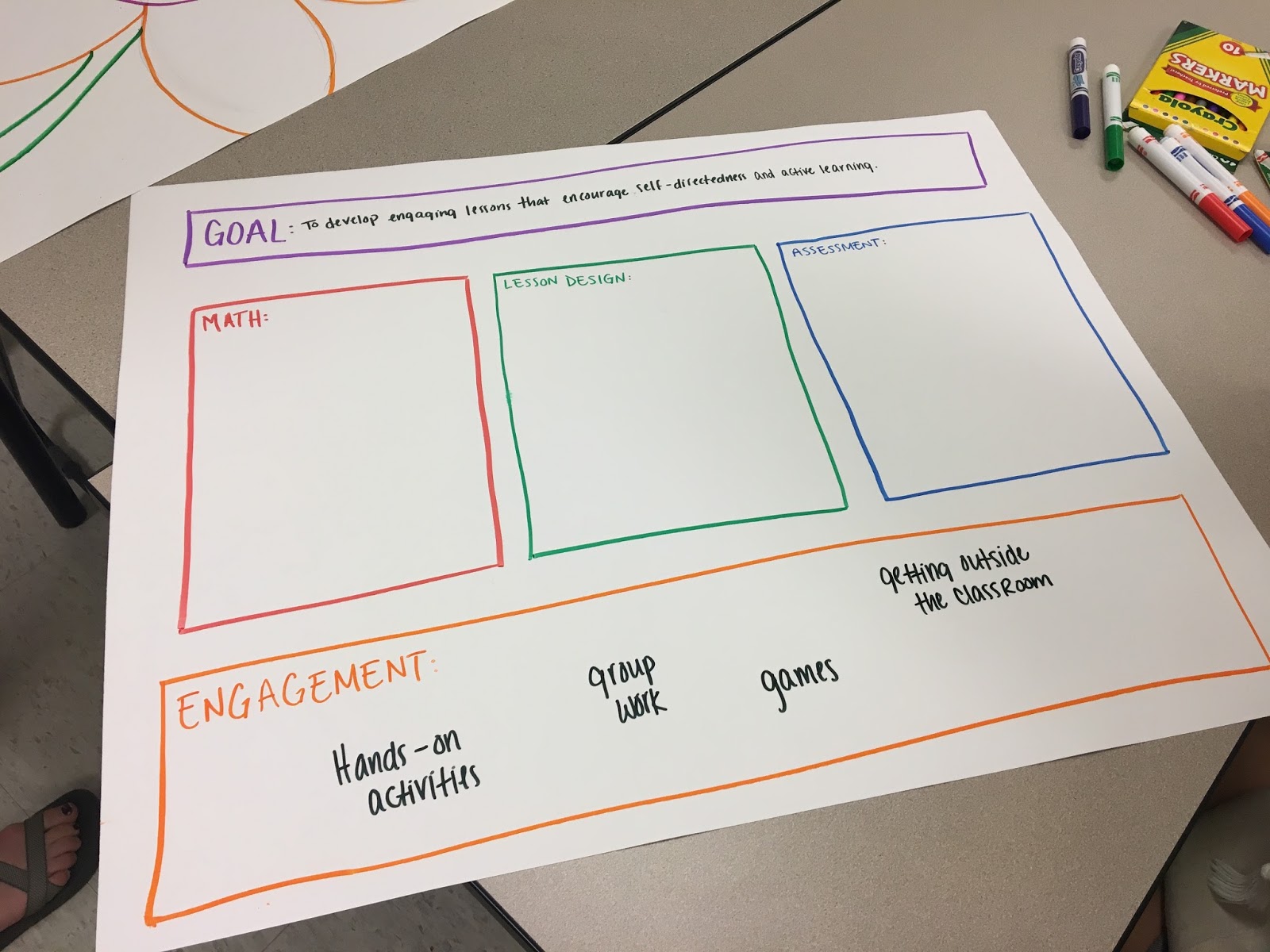

After about 20 minutes, we were ready to share our visions. We didn't have peers, teachers, or parents at our party, so we set up a series of viewing venues arranged by group.


The sharing looked a like this:


At the end of the party, the preservice teachers gave me some feedback. One said, "That was 2 hours of reflection disguised as fun."

Another complained that they didn't get to go to the viewing parties of their table-mates. I told them that was too bad but maybe they could connect with those peers after class to talk about their visions. Then I wondered out loud, "Do you think I did that on purpose?"

Friday, November 23, 2012

What's your plan to improve?

One of my favorite activities to do with teachers, both preservice and inservice is the Marshmallow Challenge. I view it as an excellent metaphor for planning and improving lessons. If you are unfamiliar with this activity, then you might want to watch this TED Talk before going any further.


Often, teachers fall into the same trap as others described in the talk. The teachers develop elaborate plans, create tall spaghetti structures, and wait until the last second to put the marshmallow on top (use this bomb timer to add suspense). Usually, the structure cannot support the added weight and it falls or breaks. 

So what does this have to do with lesson planning? I see the same thing happening in developing and implementing lessons - especially among new teachers. There is a great deal of planning beforehand in order to make things perfect. They work until the last minute, trying to get everything ready, but when the lesson finally encounters the learners it falls apart. Novice teachers are not the only ones to experience this phenomenon, however. Personally, I have had my fair share of lessons crash and burn despite massive preparation. In fact, I have wondered if the preparation was sometimes the problem.

Near the end of the talk, Tom asks, "What is your marshmallow?" For me it is a focus on student learning goals. With that in mind, and an awareness of how building on and improving prototypes increases the likelihood of success during the challenge, I have decided to try to plan differently. I want to start by designing a lesson with the least amount of support necessary to achieve the learning goals. Then I will try it out, gather data on whether or not the structure supports my goal, and make the necessary adjustments. If things go according to plan, I can create the next lesson/scaffolding using the same approach - start simple and add on as necessary.

This past week, it was interesting to watch two groups that contained members who had preformed the Marshmallow Challenge in other settings. Each followed the kindergarteners' approach of making successive prototypes. Where they differed was in their acceptance of their circumstances. 

One group kept adding on until the very last minute - continually tinkering with the prototypes. Unfortunately, they ran out of materials and the final structure was unsteady and fell over as the timer went off. A few minutes earlier it was standing tall:


The other group "finished" with about four minutes left. Given more time and resources, they might have been able to build something taller, but under the circumstances they were satisfied with their effort. They ended up besting the only other standing tower by about 6 cm.


It is only a metaphor, but I think the Marshmallow Challenge has a lot for us to think about as we consider improving education. Michigan is in the midst of considering plans for overhauling school funding (and therefore schools) but these plans have the feel of untried spaghetti towers not tested prototypes. As Stigler and Hiebert point out: 
Traditionally, Americans haven been more willing to accept dramatic failures than to applaud or even appreciate, small successes. (page 139 of The Teaching Gap)
If we are to succeed at this challenge of education reform, then we ought to heed the lessons of the Marshmallow Challenge.

TEDxGrandValley