Showing posts with label Problem Finding. Show all posts

Friday, January 31, 2014

Did I get my money's worth?

The following is not intended to be an endorsement of any product.

UPDATE: 2017 - This year the tumbler cost $42.40 (including tax) and a grande is $2.20 (including tax).


In December, I got a tumbler from Starbucks that allowed me to get free coffee every day this January. The tumbler cost $30 plus tax. My last free grande is shown to the right. I still get a $.10 discount when I use the tumbler but from now on I need to pay the regular $1.95 plus tax for brewed coffee. This got me wondering: did I get my money's worth from the purchase of this tumbler?

Will you (or your students) help me answer this question?

Wait. You need more information - such as? Go ahead and share what you need in the comments.


Tuesday, December 31, 2013

How can we pass the time?

For the past three year, we have spent New Year's Eve at the Wealthy Theater in Grand Rapids listening to Michigan supergroup, Starlight Six. They usually play three sets of music, with short intermissions between sets. During one of the breaks last year, I was looking for something to do (trying to find a problem to play with) when I noticed the light string at the back of the stage.


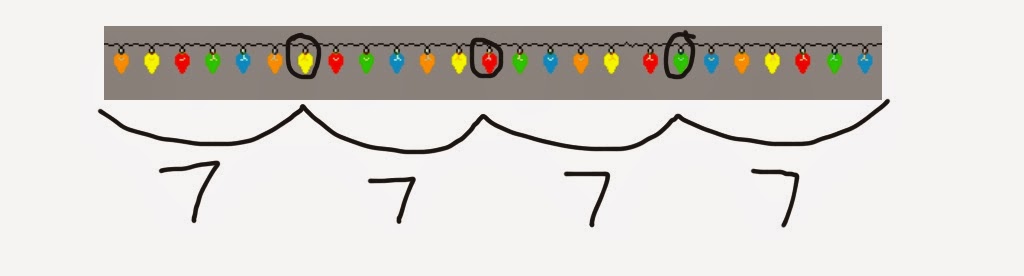
The string of 25 lights were hung in a way that I could see two groups of 13. 
This seemed quite appropriate given that it was 2013. And it got me wondering about what other groupings I might make with this string of lights.

I imagined using two interior anchor points (adding two more lights) in order to create three groups with nine in each group.
Making four groups meant adding three more lights. With 28 lights, each of these groups would have seven lights.
Five groups created a problem. When the four anchor lights, which were being double counted, were added to the original 25, I had a number that was not divisible by five. But six groups, with 25 (original) + 5 (anchor) lights, resulted in five lights per group. It had me wondering if other strings would be as "friendly" to various groupings or if there was something special about 25.

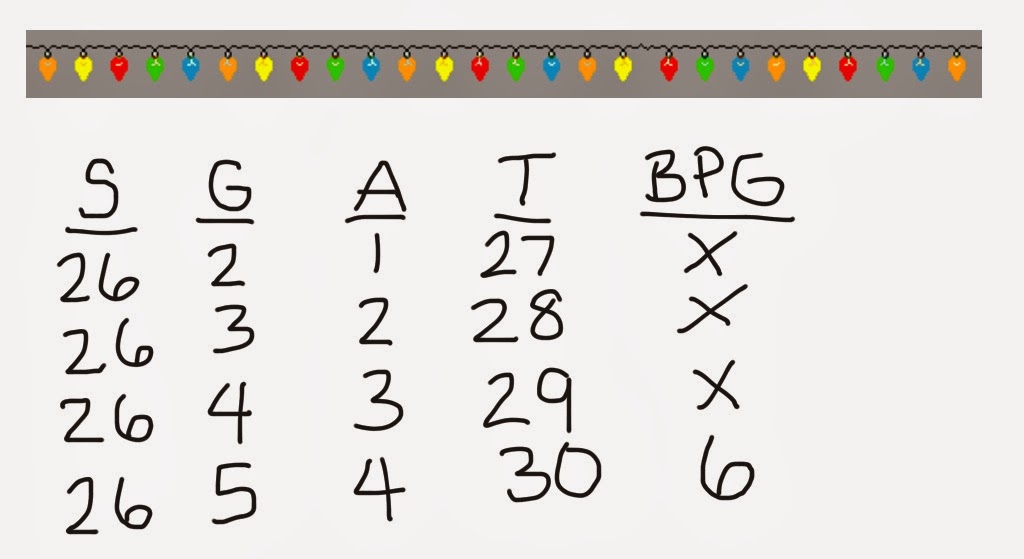
So I thought about a string of 26 lights. Two groups added one anchor resulting in 27 total, which is not divisible by two. Three groups added two anchors resulting in 28 total, which is not divisible by three. Four groups also didn't work. But five groups added four anchors for 30 total, and 30 is divisible by five - resulting in 6 bulbs per group.

This still left a lot of questions to explore. But the band was back on stage, so I filed this found problem away for another time.


Feel free to use it as a way to pass the time this coming year. Or better yet, find your own problem.

Friday, March 29, 2013

What did you think of Sir Ken?

A former student asked me this earlier today. You see, Sir Ken Robinson visited GVSU this week (news story) and shared his message about the need for creativity to be infused in education - not just something added on. I told the student something like, "He was certainly inspiring. I left feeling passionate about being an educator and affirmed in my efforts to improve teaching."

(Watch this and see if you don't agree)


"But," I added, "I'm still thinking about how to implement the ideas he shared. What does it look like?"

The student responded, "You always ask that."

My colleague, John Golden, was also at the presentation and wrote this recap. He had the same question (no surprise for anyone who knows us). John focused on education in general, however, and I want to focus on a specific example Sir Ken gave about mathematics. There's currently no transcript or video of the complete talk so some of this is based on memory and notes which admittedly are a product of my own filter. So be forewarned.

Sir Ken talked about asking a math professor in London how the math department evaluated doctoral theses. The math professor explained that the math, obviously needed to be correct, but that this was not usually a problem. So it boiled down to two things. First, the work was something original that contributed to the current knowledge-base. And second, it was aesthetically pleasing. The math professor explained that math was a way of representing the beauty and truth of the world and that a dissertation needed to be able to demonstrate that connection. (If anyone remembers this differently, I'd be happy to make the necessary adjustments. Please leave your memories in the comments.)

As I thought about these requirements, it became clear that K-12 schools often focus on the initial point, correct mathematics, while ignoring originality and aesthetics. So what would this look like if we also incorporate Sir Ken's admonition that the later elements, associated with creativity, are not added on after the fact? I think standards-based assessments and problem finding activities are two sources to consider as ways to address these expectations, but I am open to other. What do you think?

Sunday, March 24, 2013

Which floor, please?

We were scheduled to present at the MACUL Conference early in the day, so I set my alarm to go off before sunrise. Once I was completely ready to go, I took some time to look out the hotel window across the Detroit River toward Windsor, Canada. I notice a few lights were already illuminating some offices in the tower to the right. Clearly, some people were getting an early start on their day. And then one of the lights moved, and I realized that it was one of the tower's exterior elevators. As I watched the lights move up and down, several questions came to mind. So I took some video to share the experience with you. (I apologize for the quality.)

Going Down
  • On average, how fast is the elevator going as it descends?
  • Is the rate of speed, as the elevator descends, fairly constant?
Going Up
  • Does the elevator travel slower going up?
  • How long would a trip to the top of the tower take?

Waiting
At one point, there was a break in the action, and I noticed that the elevator cars stayed at their last location instead of going back to the ground floor. When they were called, it wasn't evident to me what determined which car answered which call.
  • If I was on the ground floor, what would be the average amount of time I would have to wait for a car to respond to my call?
  • What are the chances that a car would be waiting for me if I was on the ground floor? On some other floor?
Some of the questions above could be explored using the videos, but most would require further investigation. It has me wondering about the elevators in Mackinac Hall. Maybe some weekend or night I will conduct a my own experiment. 

Friday, October 5, 2012

Is it really worth the wait?

On my way home from GVSU today, I saw a lot of cars waiting at the pumps of a local gas station. My tank was half full, so I hadn't been paying attention to the prices at other stations, but $3.71 didn't seem like an especially low price-per-gallon. What did these people know that I didn't?


I began to wonder if it would be worth waiting in line to top of my tank. This got me thinking about all the information I would need to gather in order to make an informed judgement about whether or not it would be worth the wait. Here's some of what I gathered, in the form of pictures.


What else do I need to know in order to determine if it would have been worth it to stop for gas at the Admiral station?

Tuesday, January 3, 2012

Whose problem is it?

"Education systems, teachers, school districts all over the world are going crazy about problem-based learning - nothing like a good problem to solve. But they are looking at the wrong bit of it. The thing we're neglecting is to find a generation of problem finders."
The above quote comes early in Ewan McIntosh's talk at TEDxLondon. This really connects with my goal to foster sustainable learning. Here is the entire talk (it is well worth the eight minutes):

I want learners to come up with their own problems - to be able to answer, "Now what?" for themselves. Most times when I try to implement a problem finding curriculum, however, two issues interfere: trust and control. You see, I know what they need to know because I know what I learned and how it has helped me. How can I be sure learners will follow the correct path, find the right problems, if I do not lead them either explicitly or implicitly?

Here is a good example. Over the winter holiday break, I went on a hike through a state managed forest. Along the trail were a variety of signs describing interesting facts about the trees and forest management. The sign below was of particular interest to me.
I thought it had a lot of potential for use in a course on teaching and learning middle school mathematics that I am scheduled to lead this semester. It would provide a great context for the geometry section as I asked my learners to make Biltmore and Merritt Rule Sticks using the information provided. The problem was perfect, but as Ewan points out, it was also mine.

Given my interest in sustainable learning, I would be better off owning the problem myself and using it as a demonstration. It would offer an opportunity for thinking aloud about identifying problems in contexts that interest me - the first step in the gradual release of responsibility. Then, with my support, the learners could begin to find their own problems in whatever math content we must address. By the end of the course, hopefully, the learners could find problems for themselves.

With awareness and effort, I have gotten better at letting my learners lead the way. Every success allows me to trust them a little bit more and give up trying to control the curriculum. Maybe 2012 will be the year I learn to really let go.

TEDxGrandValley