Showing posts with label NCTM. Show all posts

Tuesday, May 9, 2017

Wanna Play?

Grand Valley's College of Liberal Arts and Sciences has a policy that all courses must meet and have a culminating experience during finals week. Typically, I try to do something other than a traditional exam during these meetings. Most of my students are preservice teachers, and I want to offer them an alternative way to "show what they know" and reflect on the semester; this often entails presentations. But this year we decided to throw a party.

I got the idea when I attended a session at the NCTM 2017 Annual Meeting and Exposition that was led by Kassia Omohundro Wedekind and Mary Beth Dillane - "We are Mathematicians": Building Mathematical Communities Based in Sense Making, Agency, and Joy. During the session, they talked about kids at their school hosting a math party for their peer, teachers, and parents. At the party, the kids shared some of their favorite math activities. I decided this would be a great way to wrap up the semester.

We started the celebration with a popular party game: The Marshmallow Challenge.


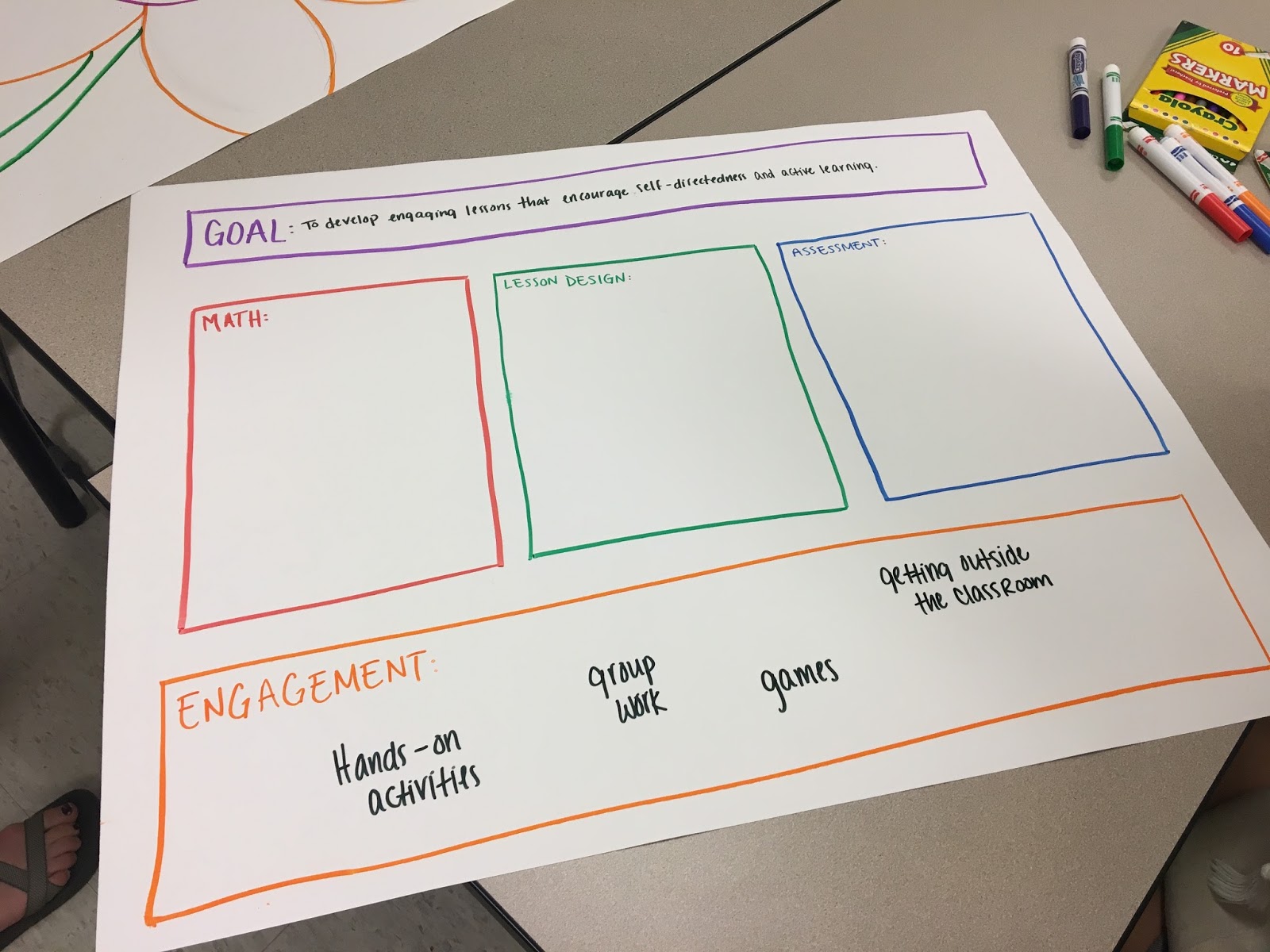
Then the pre-service elementary teachers started developing their Math Teaching Vision Boards. I got the idea from this podcast that discusses the role instructional vision has on math teachers' instructional practice.


After about 20 minutes, we were ready to share our visions. We didn't have peers, teachers, or parents at our party, so we set up a series of viewing venues arranged by group.


The sharing looked a like this:


At the end of the party, the preservice teachers gave me some feedback. One said, "That was 2 hours of reflection disguised as fun."

Another complained that they didn't get to go to the viewing parties of their table-mates. I told them that was too bad but maybe they could connect with those peers after class to talk about their visions. Then I wondered out loud, "Do you think I did that on purpose?"

Sunday, February 26, 2017

What's your next move?

Our presentation from Math in Action 2017


Description
Games are an effective way to engage students in learning. Participants will experience how to support the development of pre-adolescent mathematicians through purposeful play. [Grades 3-5]


Consider what you think it means to effectively teach mathematics. Now take the Simile Survey provided below. What are the characteristics of your simile selection that relate to good mathematics teaching?
A while back, Dr. Doug Fisher introduced me to another teaching simile: Teaching is like being an expert commentator. During the lesson, the teacher highlights important aspects of the "routine" that the student might otherwise overlook. In cases where the action moves too quick, the teacher might need to "rewind and show it in slow motion" in order to clarify some move. Here is an example from the 2016 U.S. Olympic Trials that demonstrates these characteristics. So what does this look like in math class?

Imagine we are in a 3rd-grade class playing BINGO. If the students are fluent in reading number symbols, there's not much to the game. So let's break it - add another dimension by allowing players to decompose the number that's called.
If you were in a 5th-grade class, they might ask why they can't decompose the called number into more than two addends ... or use operations other than addition. Then the challenge might be, "Can I get a BINGO with just one number called?"

After (or during the game), what sorts of things would you want the students to notice? What would you highlight and maybe have to slow down? It depends on the game and our players.
  • If I was playing the regular game of BINGO with young kids still struggling with number recognition, I might be sure to call "thirteen" and highlight ways to tell the difference between 13 and 31.
  • If we are decomposing, I might want kids to recognize that 38 can be decomposed into 30+8 or 31+7 and highlight the concept of compensation.
  • For 5th graders, I might show how "thirteen" can be written as 13+8/(9-7)-4 and highlight an important property of zero in our number system. [To demonstrate another important property of zero, ask students if they could cover the entire board if "thirteen" was called.]

It is important that teachers have the opportunity to play games before using them with their students. That way the teachers can consider possible modifications (ways to "break" the game) that would meet their students' needs. It also gives them experience playing the games that can lead to insights into important mathematical aspects encountered while playing that the teachers might want to highlight for their students.

Game Centers 
Number and Operations - Fractions 
Grades 3-5 

=====
Other Game Resources
=====

After playing the games, we reflect on our experiences using Math Teacher Chair:
  • What games did you play?
  • So what mathematical ideas would you want to highlight?
  • Now what would you do to break the game or slow down the play so students would benefit mathematically from playing?

Thanks for your participation. You can reach us using the following contact information. 


"Rocket science is child's play compared to understanding child's play."

~ Unknown


If you are attending the upcoming 2017 NCTM Annual Meeting and Exposition in San Antonio, we will be presenting this session again. 
We promise it will be better next time thanks to the feedback you've provided on your session evaluations (or in the comments below).

Friday, September 19, 2014

Who would you want to work with?

We are in the process of making teacher-groups for Family Math Night. The teachers (MTH 221 students) will work together to develop an activity related to specific standards, try out the activity with K-6 students, and reflect on the activity's effectiveness. Throughout the project, teachers use frameworks from the 5 Practices and the Principles to Actions to inform their efforts. This is one of the ways I try to embed the work of teaching into the course.


Because I also want to prepare pre-service teachers to be your future colleagues, I am soliciting your help in identifying norms for collaboration. What are some things you look for in colleagues with whom you choose to work? I am trying to come up with five criteria that the teachers could consider as they evaluate their interactions with their peers.

I have a compulsion to use acronyms, so I made the checklist on the right using some suggestions shared on Twitter. Does this list work for you? If not, how would you adjust it? Please do not be limited by this format as you offer suggestions in the comments.

Thank you in advance for your contributions to the development of these future educators.

Tuesday, April 15, 2014

When should we intervene?

More on the session
During our session at NCTMNOLA, participants explored several games that offer opportunities to encounter mathematical content and processes associated with the Common Core State Standards for grades K-2.


As the teachers played the games, or observed as others played, we asked them to keep an eye out for meaningful mathematical moments that might be shared with the entire group.

One of the games introduced many of the teachers to a new manipulative - a rekenrek
A teacher in this group anticipated that students might have a hard time following the directions for this game and treat each row as a separate roll. She wondered when to intervene if a student did this. 

Get the app
I am sure I gave her a very unsatisfying answer, "It depends."

It depends on my goal for the lesson. If the lesson is about using the structure of the rekenrek to help students visualize groups of tens and fives in regards to place value understanding, then I might intervene. However, if I want the lesson to focus on decomposing numbers in order to make groups of ten, then I might wait until the whole class discussion (reflecting on the learning); this choice allows us to talk about it as a group.

It also depends on whether or not everyone is exhibiting the same issue. I hate putting out a lot of little fires. If I saw everyone doing this, then I might intervene with the entire group since there would be a lack of diversity in what students could share during the reflection. However, if it was a single student, then I could decide whether or not to select this approach for the reflection and where in the sequence (see Orchestrating Discussions).

So let's assume that my goal was about making tens and only Patsy played the game in this way. After having a few students who followed the directions as written share, I would move our attention to her "game board."
I want to share Patsy's work because she played a slightly different game. She answered a different question. If I wanted to know what Patsy rolled during each turn, I could find out from her rekenrek: 10 the first roll; 7 on the second; on the third a 3 (coincidence there, eh?); 9 on the fourth; 1 on the fifth; and 4 on the sixth roll. But the game wants us to say how many beads we have total and how many we need to get to 100. So with an elbow partner, I want you to devise a plan for finding these two numbers, the total and what's left to get to 100, but don't find them - yet. Ready? Go.
Although it is not what I expected (probably because it is not what I expected), I really like what Patsy's new game does for the lesson. In fact, I might tuck this example away for another time when we play the game. Then, if no one else plays it this way, I can still use it in our discussion because the game provides a shared context. This context, at least once, created an interesting problem for students to solve. And that was the main point of the session:


Tuesday, April 1, 2014

Do you need some ideas for a sub plan?

The 2014 Annual Meeting & Exposition of the National Council of Teachers of Mathematics (NCTM) is being held in New Orleans this year. I am taking a group of preservice math educators to the conference, as well as co-leading a workshop on Playing with the Common Core with my wife. This means that I (like many other teachers attending a conference that meets during the school-week) will be away for several classes and in need of sub plans. Fortunately, for me, I teach teachers and they have several projects they can work on for the two class periods that I will miss - no sub needed, just plans. But I remember being a middle school math teacher in need of plans that could be "sub-proof" while I was away facilitating professional development at other districts. My favorite activity to assign was "Rewrite the Text."

Now it might be called "Math Book Makeover" in homage to Dan Meyer's TEDxNYED (see below). In fact, there are a lot of things I would change, given what I know now. If you are looking for some sub plans, here is a workshop I might use.

Math Book Makeover Workshop
My thoughts are in blue.

Schema Activation: (Done before I leave) Chair-Pair-Share
  • What would you expect to see in a math book?
  • Which of these things helps you learn math?
  • Are there any things you think are missing?
  • Are there any things you would get rid of and why?
Focus: (Watch before I leave) Math Class Needs a Makeover


We are going to watch a former math teacher talk about some ways we might change math class. I want you to pay particular attention to ideas associated with changing math books and how we might apply these ideas to our textbooks. Please keep a record of these ideas so we can talk about it later.

I know that much of this might go beyond a middle school learner's current level of understanding, but I believe he or she can get a sense of some ideas of things to do to change the text. The goal is to immerse the learner while focusing on what is important.


Whole class discussion: What were some of the ideas you might consider applying to a makeover of our math book?

I hope they will notice that we need to change the text so it:

  • Supports reasoning;
  • Promotes problem solving;
  • Matters; and
  • Incorporates dynamic resources (video, technology, ...)

Activity: (While I am gone) The Makeover

Depending on the number of days I was going to miss, I might assign a section for each day. I know this would probably not be enough time for my learners, but I am in the habit of giving learners too much to do because it forces them to make choices about what is really important to accomplish. For each section, they would need to identify what part of the lesson would go, what would stay, and what they would add. I could require particular features (practice problems, assignments, technology, assessments, rubrics, teacher notes, ...) if it made sense given where my learners were in their understanding of math books.

The level of polish would depend on my audience and purpose. If I am the audience and the purpose is to simply to see how they thought about revising the text, then sticky notes might be all I needed to see. But if the purpose is to really revise the sections and perhaps use some of the ideas with future learners (leaving a legacy - another good TEDxNYED Talk), then I might want something more substantial. This might require giving them more time and feedback. And, if I want to avoid checking their Google Docs at the hotel after attending a day full of sessions, some time in class after I get back.

Reflection: (At the end of each period when I am gone) Glows and Grows
  • Glows: What are the two parts of the revision that you are most proud of and would want to share with others? What makes them so good?
  • Grows: What are the two parts of the revision that you believe still need some work before they are ready to share with others? What work do they need?
These questions put the learners' work into perspective. I can spend more time evaluating the Glows, because they are presumably the best work, and allow for some approximation in the Grows. The learners can also use this reflection to make a plan for what comes next.

=====

If you are looking for sub plan ideas, I hope this helps. As a middle school teacher, one of the reasons I liked this plan was because it was so adaptable to whatever content we were currently exploring. I did not need a special project that addressed some specific content. I could also avoid using a plan that was disconnected from our current work. It seemed like an approach that could be used with any section in any middle or high school text.

So what do you think? Would a workshop like this work as a sub plan for you? Why or why not? Please leave your thoughts in the comments.

P.S. If this doesn't work for you, then check out these sub plan ideas from Julie Reulbach.

Saturday, December 1, 2012

How does a home workshop work?

This past week, Esther Billings, John Golden, and I presented Making Workshop Work in Mathematics at the NCTM Regional Conference in Chicago. One of the problems with presenting at these conferences is that the session description is due almost a year before the presentation. So while the program says, "explore several mathematics lessons and assignments that use the workshop model," we decided that the session would be more meaningful to participants if we worked through a single workshop, highlighted the workshop phases and research, and discussed how the workshop structure could support exploring the Standards of Mathematical Practice.

Although we provided a few minutes for participants to reflect on how they might apply what they learned about workshop to their classes, we were not explicit about using the approach on assignments. I hope to remedy this oversight by sharing a home workshop I used recently in my Teaching and Learning Middle Grades Mathematics course. This comes near the end of a unit on rational numbers.
*****
Doing Math Workshop (CGI Grouping Stories)

Objective: The learner will use representations to support their thinking and make their thinking visible to others as they find solutions to grouping stories involving rational numbers.

Needs: One hour and a copy of CGI Grouping Stories

Schema Activation: Reviewing Grouping Stories (no more than five minutes)
Recall that we used Grouping Stories from Cognitively Guided Instruction to provide context to multiplying and dividing integers. Review the different stories provided below and consider what it might look like as learners use the given contexts to compute their answers.


Buschman, L. (2001). Using Student Interviews to Guide Classroom Instruction - An Action Research Project. Teaching Children Mathematics, 8(4), 222-227.
Focus: Goldilocks Problems (no more than five minutes)
As you read through the CGI Grouping Stories, you will notice that the values in each story have been left for you to choose. The goal is to select the row of values that is not too soft (so easy that it does not require any thought on your part) and not too hard (so difficult that you would not be able to make progress without a significant amount of help). In other words, find the "just right" numbers. In the space on the right, record the representations you used to support your thinking so you can make it visible to others.

Activity: CGI Grouping Stories (no more than forty minutes)


Reflection: What? So What? Now what? (at least ten minutes)
As you look back at your efforts, pick the one record that best demonstrates your ability to use representation to support and share your thinking.

  • What support did the representations provide as you worked on this story?
  • So what would you want others to see as you share your efforts?
  • Now what does this mean for you as a teacher - as you consider designing rational number computation lessons?
*****
The next class period, we usually have a math congress where some of the students share their work with their peers and discuss their reflections. If there is any interest, I will try to provide some generic examples of these in a future post. Please leave your interest or your questions in the comments.

Monday, October 22, 2012

Which way is ... ?


A preservice teacher leading a review for a quiz on rational number computation invited me to watch the lesson and work with her to improve on it. The objectives addressed in the review activity were from the Michigan Grade Level Content Expectations (GLCE):
  • N. FL. 07.08 (GLCE): Add, subtract, multiply and divide positive and negative rational numbers fluently 
  • B. N. FL. 07.09 (GLCE): Estimate results of computations with rational numbers
But the preservice teacher was also interested in developing conceptual understanding - especially around the idea of how multiplying and dividing by numbers between 0 and 1 impact the result. A good activity from NCTM (pdf) was found and modified in an effort to achieve these goals.
Move down or sideways (never up) through the maze from Start to Finish. You may not retrace any steps. Begin with 10 and as you move along a segment do the indicated computation. Record your steps on the scorecard. Your goal is to find the path that results in the largest (or smallest) value when you reach the Finish.

After the lesson, we discussed ways of using the activity more effectively. The first idea was to model what a path looks like. Because this kind of activity was new to the students, it took them a while to understand what was expected of them. For example:
What if we just followed along the left-most edge?
  1. 10 x 0.9 = 9; 
  2. 9 x 1.75 = 15.75
  3. 15.75 + 5 = 20.75
Next, without doing any computation, we would ask the students to predict the path that would result in the greatest result or the least result. Making predictions is a great way to develop interest in a task. Student would share their predicted path and the rationale for their choice. This would provide some insight into the students' number sense related to multiplication and division of rational numbers. 

Then the students would estimate the results of several paths. This would allow them to check out their predictions and refine our list of which paths might represent the largest (or smallest) value. Also, this would address objective B. N. FL. 07.09 from above.

Finally, the students would be asked to compute the path they believed would result in the largest (or smallest) value [N. FL. 07.08]. Calculators are not allowed in this classroom but we decided that we might allow students to use calculators on up to half of the calculations. That way they would be exposed to the idea of using calculators strategically instead of with an "all-or-nothing" mindset.

As an extension, we might ask the students to find the easiest or hardest path to follow without using a calculator and why. We thought this would offer the students an opportunity to be metacognitive. It would also provide us with information on areas where students could improve on their fluency.

The preservice teacher was able to apply some of these subtle shifts to her later class with success. She writes:
...they did much better!  They were excited to do something "more fun than boring problems."  I was really happy with the responses I got...
What are your thoughts? How would you improve on this activity? Why?

TEDxGrandValley