Showing posts with label Music. Show all posts

Wednesday, June 24, 2015

Why do you want to learn to play the mandolin?


It was time to learn something new. That was my mindset when I signed up for mandolin lessons at Earful of Fiddle Camp. Even though I have had some musical training (piano and flute), I knew learning to play a stringed instrument was going to be a challenge. So I spent last week swatting mosquitoes and strumming strings, all so I might someday call myself a mandolin player.

Laurel and Michael
of Red Tail Ring
Oh, and as the sign says, we also got to listen to some old time music. On Tuesday, Red Tail Ring taught a workshop on harmony in the afternoon and put on a concert that night. Afterward, I asked Michael (he played the mandolin on a few songs) if he ever gave lessons. He said, "Yes." And then, perhaps noticing my age, he asked, "Why do you want to learn to play the mandolin? What are your goals?"


I responded, "Don't worry, I'm not looking to replace you." He laughed, but I could see that he was serious about knowing my musical aspirations. Perhaps his instructional approach would depend upon what I wanted to accomplish.

"I'm struggling with my fingering."

He asked, "You mean your fingers are tender?"

"They are," I said looking at the blisters on my fingertips, "but I mean creating a clean sound when I play."

He explained that the two were related. Once calluses formed, I'd be able to press on the strings with more commitment. However, we still hadn't addressed the original questions. He tried again, "Who do you want to play with or for?"

Now I got it. "Mostly with my family. My wife and son-in-law are here, too. You know, like around the campfire. Oh, and I'd like to be able to play for my grandson; songs like Puff the Magic Dragon and Itsy-Bitsy Spider." This made sense to him and we made arrangements to connect later in the summer to arrange some lessons.


At the end of the week, campers perform for the rest of the camp, friends, and family in an event called, Earful of Idol. When the group I played with finished our song, I was reminded of my conversation with Michael. I had been miserable most of the day trying to memorize the song. During the performance, I only played about half of the notes, and only half of those at the right time. My "bandmates" picked up the slack and the audience was generous with their applause, but I was ready to quit mandolin. There was no point continuing if I wasn't enjoying it.

That's when Michael's question hit me, "Why do you want to learn to play mandolin?" My purpose for picking up the mandolin was to have fun with my family. It wasn't to perform in front of strangers. Even the best audience couldn't hold a candle to this guy.

Vance wants more cowbell!
Maybe I'll be grateful I played at Earful of Idol someday - maybe not. (I do not subscribe to the "someday, you'll thank me" school of teaching.) At the very least, I gained empathy for students who "quit" math because the effort does not seem worth the experience. Whether it's music or math, learners need to find their own purpose in order to stay engaged in learning.

Tuesday, January 28, 2014

What did you learn?


Another day of classes canceled. That's two this semester, or one-fourteenth of our face-to-face meeting time. Immediately, I began considering ways to make up this precious time but then I began to see the Twitter complaints of some of my students who were getting extra assignments from their other professors. This isn't intended to be a criticism of either my students or my colleagues - just an observation. And it raises the question: what do I want my students to learn from my class?

It was a question that I was recently discussing with another professor who is also teaching preservice elementary teachers. We came to the conclusion that, if we are honest, much of the content (mathematical and pedagogical) in our course does not last until our students have their own classrooms; this is both horrifying and freeing. I try to concentrate on the the freeing. Although we have content proscribed by a common syllabus, we can take the advice of Mike Schmoker and Focus on what we think is important. I want to make the most of the limited time we have together by focusing on building the capacity to learn new things and the desire to do so.

And then I found out Pete Seeger died, and in all the tributes I was reminded of his song, What Did You Learn in School Today?


It is not enough for me to identify what I want my students to learn, I also need to be aware of what they are actually learning. In the song, the hidden curriculum, intentional or not, is made visible and the possible consequence made implicit. While I never want my students to non-critically consume content, unintended consequence to my instructional actions always need to be considered. I might have designed what I thought was the perfect experience to replace today's missed class. However, the result might have been a blow to my efforts to foster a positive affect toward learning how to teach math.

I guess I can live with the choice to let today's learning be in the hands of the learner.

Tuesday, December 31, 2013

How can we pass the time?

For the past three year, we have spent New Year's Eve at the Wealthy Theater in Grand Rapids listening to Michigan supergroup, Starlight Six. They usually play three sets of music, with short intermissions between sets. During one of the breaks last year, I was looking for something to do (trying to find a problem to play with) when I noticed the light string at the back of the stage.


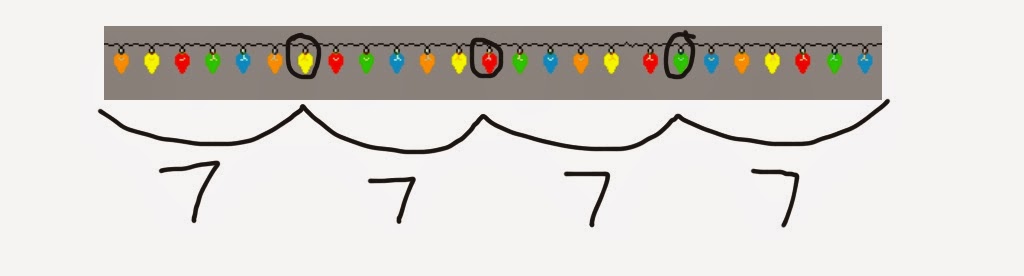
The string of 25 lights were hung in a way that I could see two groups of 13. 
This seemed quite appropriate given that it was 2013. And it got me wondering about what other groupings I might make with this string of lights.

I imagined using two interior anchor points (adding two more lights) in order to create three groups with nine in each group.
Making four groups meant adding three more lights. With 28 lights, each of these groups would have seven lights.
Five groups created a problem. When the four anchor lights, which were being double counted, were added to the original 25, I had a number that was not divisible by five. But six groups, with 25 (original) + 5 (anchor) lights, resulted in five lights per group. It had me wondering if other strings would be as "friendly" to various groupings or if there was something special about 25.

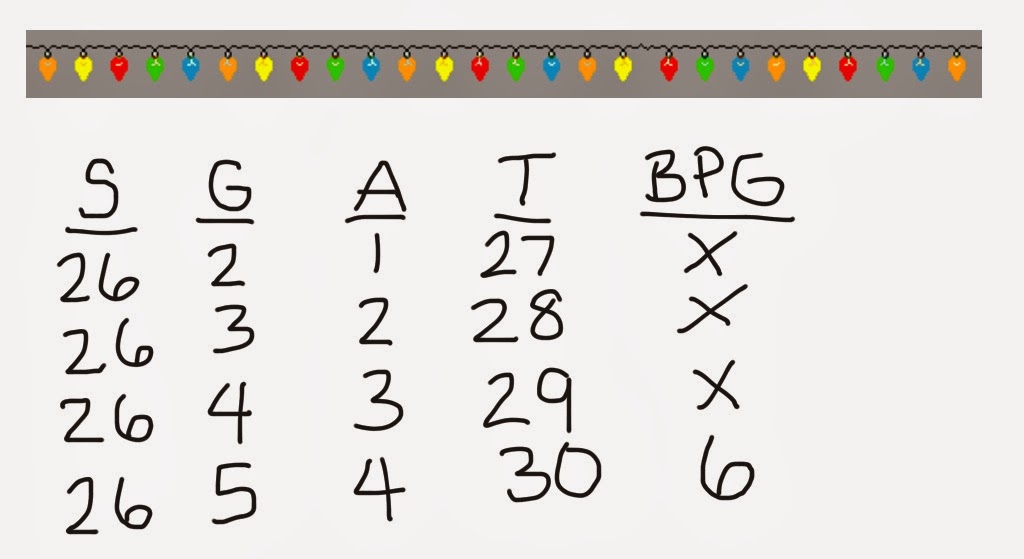
So I thought about a string of 26 lights. Two groups added one anchor resulting in 27 total, which is not divisible by two. Three groups added two anchors resulting in 28 total, which is not divisible by three. Four groups also didn't work. But five groups added four anchors for 30 total, and 30 is divisible by five - resulting in 6 bulbs per group.

This still left a lot of questions to explore. But the band was back on stage, so I filed this found problem away for another time.


Feel free to use it as a way to pass the time this coming year. Or better yet, find your own problem.

Thursday, November 7, 2013

What did/does the 'A' say to me?

In the previous post, I used the song What Does the Fox Say? to frame a discussion about what grades communicate to various stakeholders in education - in particular students and teachers. It is my view that we do not share a common understanding of what a grade means and this impacts learning. I suggested some of the different ways we interpret an A by modifying the song's lyrics. Readers responded in the comments with what an A grade meant to them as a student and what they hope it says to their students as a teacher. Now is the time for me to share my perspectives about what did/does the A say to me.

When I got an A, I thought that I had pleased my teacher. I distinctly remember having a conversation with a friend who was struggling in school about how I achieved success. I tried to find out what the teacher wanted and then went about meeting that vision. The grade I got would tell me how close I came to giving the teacher what he/she had in mind. It did not matter the subject, the teacher was the all-knowing arbiter of my work. For me, school was not so much about learning as it was mind-reading.

As a new teacher, I simply flipped this perspective. An A meant that the student had done at least 90% of what I expected (i.e. what I would do). To my credit, I did not want my students to read my mind so I made my expectations very clear. I got a lot of student-work that looked just like my work. Instead of mind-readers I was fostering mimics.

Now, I see an A as representing what Joyce and Showers (2002) called Executive Use. The student has demonstrated complete content competency (I was uncomfortable with idea that there might be a 10% gap in a teacher's knowledge) and an ability to analyze under what circumstances the learning could be applied appropriately (phronesis) or how to adapt it to new situations. Granted, because I mostly teach teachers, this standard might be easier to implement now than when I taught middle school math. Still, I have applied a similar idea in a College Algebra course with some success - it was a tough sell.
Basically, I want an A to say to students that they have achieved sustainability in the topic being graded. They can apply what they have learned beyond what we talked about in class, and they can learn more on their own if needed. The teacher (me) has become obsolete.

Friday, November 1, 2013

What does the 'A' say?

I was introduced to this little ditty for the first time last week. 
[Warning:  possible earworm]

Dog goes woof
Cat goes meow
Bird goes tweet
and mouse goes squeek

Cow goes moo
Frog goes croak
and the elephant goes toot

Ducks says quack
and fish go blub
and the seal goes ow ow ow

But there's one sound
That no one knows


What does the 'A' say?

Well-done-well-done-well-donedonedadone!
What does the 'A' say?

You got 90% or better!
What does the 'A' say?

De-de-de-de-de-distinguished!
What does the 'A' say?

Ah-ah-ah-ah-ah-ah-ah-ah!
What does the 'A' say?

Big bold type
Pointy head
Causing joy
and spreading dread
...

So that's enough of that. But in all seriousness, the song reminded me of a project I have been interested in for some time: what does a grade of 'A' communicate to students, to their parents, to other educators, to the community? I have often wondered if we are all on the same page when it comes to grades and what they say. At one point, I thought about putting a questionnaire in the mailboxes of my colleagues asking this question, but for some reason I never got around to it.

Until now.

In the comments, please share what an 'A' said to you as a student and what you hope it communicates to your students as a teacher. I'll share what I really think the 'A' says after you all get the ball rolling. Thank you in advance for your participation.

UpdateThanks everyone. My response got a bit long for a comment - so, for what it's worth, you can find it in the next post.

Tuesday, June 4, 2013

What will you give?

.
We just returned from a luncheon/fundraiser for Artists Creating Together (ACT). This is an amazing organization that "brings people with disabilities together with artists and art projects." At the luncheon, we were entertained, fed, given a handmade key chain, and provided information about ACT's efforts.

After lunch we watched this video:


Then the mother of one of the individuals highlighted in the video, Drew, gave a moving speech about what ACT has meant to her family. Finally, we were asked to consider what each of us might be able to give to support programs like these.

This was not a surprise. After all, it was a fundraiser. But it got me thinking.

I am grateful for organizations like ACT that are supporting people who are often left on the margins, and I would encourage you to support their work by going here and making a donation. However, when it comes to the arts, we all benefit from creative experiences. Unfortunately, in the current educational climate of college and career readiness and teacher accountability, "specials" like art and music are often the first to be sacrificed because of a lack of resources - time (spent instead on test-prep) and money (spent instead on standardized-tests).

I long for an educational system where tests and test-prep are done outside the school day, and where we fund the arts and hold fundraisers for standardized tests.

Wednesday, January 2, 2013

Is it a performance or playing?

We spent much of our break between semesters attending concerts by Michigan musicians (Joshua Davis, Max and Ruth, Seth and May, and Starlight Six). As often happens, I began to consider how what I observed during these concerts might apply to teaching. This was especially true when we got to see Joshua Davis at two different venues on December 13th. The first was at a theater in Frankfort, Michigan showing a movie to which Joshua contributed. Later, at an after party, he played in a pub across the Betsie River in Elberta.


At the theater, Joshua performed before the movie while photos from his trip played on the screen behind him. He shared a bit about the project and a few songs that had resulted from the experience. I saw this as a performance because he had limited time to share a planned set of his "best material" in a polished fashion to an audience he could barely see beyond the first few rows. 


His playing at the pub was much different. Joshua was set up on a "stage" separated from the audience by a pathway that many of the patrons used to get from the bar area to the bathrooms. During his set, he joked with the people as they passed by and interacted with the audience. We yelled out requests and he obliged. Furthermore, it was clear that he was trying out some new approaches to familiar songs. I call this playing because it was more relaxed and playful than his earlier performance.


As I reflected on the differences between these two shows, I realized that I need to be better about distinguishing between performing and playing in my practice. There is a place for both in teaching, but I am afraid I have not always made an intentional choice about the approach I will use during a lesson. When there is limited time, little opportunity to interact with the audience, and a need to share my best, most polished material, then a performance might be the way to go. Otherwise (and if I am honest, most times), I would be wise to be more playful in my teaching - trying out new things, seeing how the audience responds, and making the necessary adjustments.

And before too long, maybe I can schedule an "open-mic lesson." Of course, there will need to be intentional efforts to turn over to the audience the responsibility of making music. Still, it would be interesting to hear how they might interpret the music and make it their own. 

Friday, July 27, 2012

Who will be the math education savior?

Last night, my wife and I celebrated our 15th wedding anniversary with a house concert. Josh Davis, one of our favorite Michigan singer/songwriters, performed. We had supported his trip to Palestine as part of a project by On the Ground Global, and the house concert was his way of saying thanks. (Below is a video from his trip.)


As a Jewish-American, Josh brought a unique perspective to the trip. He told many stories about the ten days he spent there and sang several songs he wrote based on the experience. In one of the stories, he shared an interchange on spirituality that he had with one of the Palestinians who hosted him. The man gave him a set of Muslim prayer beads with the explanation that everyone needs guidance through the darkness.


This got me thinking about recent discussions related to math education. It might be hyperbole to say that these are dark times to be a teacher but there certainly seems to be a cloud over the profession. Understandably, some might reach out for a savior to guide them. We need to be careful.

I am a firm believer in the power of inspiration - hearing someone else's story or idea and considering ways to apply it to our own situation. My blog is filled with examples of this. But for me, it is even more important that our efforts be authentic. Here is a story from Alan Cohen's The Dragon Doesn't Live Here Anymore that seems appropriate:
There is a story from the Jewish Hassidic tradition that I would like to share with you. Rabbi Zusya, a pious and revered sage, was lying on his deathbed, weeping. His students stood by him perplexed. 
“Rabbi, why do you weep?” one of them ventured to ask, “Surely if anyone is assured a place in the kingdom of heaven, it is you!” 
The sage turned his head toward his beloved students and began to speak softly: “If, my children, when I stand before the heavenly court, I am asked ‘Zusya, why were you not a Moses?’ I shall have no hesitation in affirming, ‘I was not born a Moses.’” 
“If they ask me, 'Why, then, were you not an Elijah?' I shall speak with confidence, ‘Neither am I Elijah.’” 
“I weep, friends, because there is only one question that I fear to be asked; ‘Why were you not a Zusya?’”

While some people may ask me, "Where are your 3,000 videos?", I am not Sal Khan and that medium does not match my skills. And when others ask if I have Meyer-ized my lessons, I can tell them no because it does not match my style. For years I taught as others taught and I do not want to go back to those times. I am comfortable and confident in my teaching but that is not to say complacent. Thanks to all of you, I continue to find ideas that inspire me.


So who will be the math education savior? You will. And you. And you. In fact, there was a large group of them meeting recently at Twitter Math Camp. Check them out here, and be prepare to be inspired.

Updated 6/17/13: Below is an interview and performance by Josh Davis where he describes his encounter with the Palestinian who gave him the prayer beads.

Monday, June 4, 2012

What's your story?

This past Friday we attended the release party of the Harvest Queen cd at Kauffman Auditorium in Marquette, Michigan. (The story of how this project came to be is told here [Kickstarter Video] and here [WNMU interview].) The concert, which included traditional and new waltzes, was amazing, but it was only a portion of the overall event. Crossing Paths was intended to be an opportunity to explore various connections between local food and music.

In the afternoon, Kailin Yong conducted a violin master class for players of all ages and abilities. While my wife attended this hour-long class, I went for some local coffeeWhen I returned, Kailin was answering questions from those assembled on the stage. Someone asked him to explain when he started improvising in music.


Kailin responded by playing a beautiful, classical melody and then said (to the best of my memory), "I was very good at telling this story - an old Italian's story. But I wanted to tell my own story. I had been playing for years before I felt free to improvise. I do not want my students to have to wait as long as I did, which is why I had you working on improvisation today."

This reminded me of what Jonah Lehrer shared in Imagine about Yo-Yo Ma
"I was nineteen and I had worked my butt off," Ma told David Blume of The New Yorker in 1989. " I knew the music inside and out. While sitting there at the concert, playing all the notes correctly, I started to wonder, 'Why am I here? What's at stake? Nothing. Not only is the audience bored but I myself am bored' Perfection is not very communicative." (p. 86)
In both cases, expert musicians found being perfect was not enough. They longed to express themselves. They wanted to tell their own story or, at the very least, find a way to add a part of themselves into the retelling of the story of some other songwriter.

It seems to me we spend a lot of time in math class trying to get our students to retell someone else's story perfectly. The standardization of the curriculum leaves little room for learners to improvise and add their uniqueness to the mathematics. It is no wonder that most students see mathematics as a static set of rules. Whether we "tell" them the rules or have them "discover" the rules it amounts to the same thing - they are playing someone else's tune.

I am glad that I returned before violin master class was over (It turns out my compulsive timeliness can come in handy.) Thanks to Kailin's answer, I want to plan more opportunities that allow learners to improvise. I, too, do not want them to have to wait as long as I did to pick up this skill.

Monday, February 13, 2012

Teach like Adele

Following a post on how entertaining/engaging lessons are antithetical to sustainable learning with the idea that I want teachers to employ an entertainer's approach to singing may seem inconsistent. I hope you will bear with me, though, because I believe two performances from last night's Grammy Awards actually illustrate the point. As I watched Katy Perry and Adele sing, I was taken by the different approaches taken by each.

Now, I am willing to concede that what I am about to write may be based on generational preferences (I turn 50 this year). While I found Katy Perry's performance entertaining, it distracted from the song. I ended up focusing on surface features - the stagecraft. Adele, on the other hand, seemed focused on the song. There were no distractions. I knew what her performance was about. It felt authentic. And her power and passion affected me.

This is what teaching ought to embrace - focus on the song, not on the performance.


Updated February 18, 2012
I woke up this morning to this piece on NPR's On The Media examining Adele's song Someone Like You. The piece made two things abundantly clear. First, I am not alone in finding Adele's songs moving. Second, I do not know enough about musical performances to make statements like I did above.

It turns out that there is a science to musical performance and Dr. Daniel Levitin is doing the research. He has found that listeners want novelty, just not too much of it. He says, "If the music was completely surprising we would be disorientated. On the other extreme, if the music was completely predictable we'd grow bored with it and it would seem banal. And what the composer has do is find that balance and get it just right - the Goldilocks' Zone." This is accomplished both through writing the music and singing the music. An example of the latter is creating tension by singing slightly out of key but sliding to the correct note (appoggiatura).

Dr. Levitin explains how Adele does all of these things in her Grammy Award winning song. She starts with something simple and familiar. This is followed by several surprises: (1) a tempo change corresponding to the message of the lyrics; (2) an octave change (perhaps representing a change in perspective?); (3) using appoggiatura to suggest instability; and (4) a lower register meant to convey the emotion creeping to the surface. And host, Brooke Gladstone wraps it up saying, "It isn't just about the song. It's also about the performance."

Busted! Like many people who think they can distill teaching into a few "best-practices," I thought I could take two musical performances and identify what works and what doesn't. My efforts failed to take into account all that goes on in the writing of the song and the planning of the performance - even when it seems to be so simple. I hope I learned my lesson, but probably not. I am a sucker for a good teaching simile.

TEDxGrandValley