Showing posts with label Workshop. Show all posts

Tuesday, November 22, 2016

Where are we in the SA F A R I?

I might have gotten a bit ahead of myself in the last post (or perhaps I am building suspense - you decide). Before I introduce you to the Carousel Lesson Design process, let me explain a bit more about the SAFARI prototypes. This should put the framework into a clearer context.


As I said, SAFARI is based on an instructional approach called the workshop model. SAFARI is an acronym for the components of the model [Schema Activation, Focus, Activity, Reflection, and "I want to ..."], and in Swahili it means journey. So in designing a lesson, we are thinking about it as a journey from the known to the new.


One thing that design thinking has shown me, is that this journey also reflects the flair and focus necessary for innovative thinking.
The Schema Activation begins with a flair. Sometimes referred to as the anticipatory set, it ought to be an open-ended invitation for everyone to join the journey. Next, the lesson quite literally Focuses the learners' attention on what to look for during the journey; this might be a "think aloud" in typical workshop lessons. Entering the Activity portion, the lesson once again flairs - allowing each learner room to roam. Here you might encounter what Dr. Jo Boaler refers to as a "low floor, high ceiling" task. After a set amount of time exploring, we refocus by Reflecting on what was important during the activity. We should not wait until everyone is finished before making time to consolidate our thinking. In fact, we want students to cry out for more time; it's what Ellin Keene calls fostering learning lust. Finally, we ask learners to consider what comes next by brainstorming "I want to ..." statements related to the lesson. Perhaps they want to spend more time exploring the task they didn't finish. This represents the final flair until tomorrow when the journey starts all over again.

After explaining the components to my teachers, I give them 10 minutes to develop three different SAFARI lessons related to some topic.
At the end of the 10 minutes, I ask the teachers to share their prototypes with a peer for feedback. The teachers are often resistant to share unfinished products because of the implicit need for perfection usually associated with typical lesson plans. I remind them, however, that they had, on average, three-and-a-third minutes on each prototype. So no one expects their lessons to be perfect.

Afterwards, the teachers express appreciation for the process. Not only have they outlined three possible lessons that they could use in their classrooms, but because the lessons were incomplete their peers were able to add innovative ideas in the blank-spaces. "I wouldn' have thought of doing it that way," one teacher admitted. She continued, "And if I had created a full-blown lesson plan, I don't think [the other teacher] would have been able to see and share this amazing idea."

It's a good reminder that the creative process is often about finding and cultivating the cracks that allow new ideas to grow. So how does this get any better? Here's what you've been waiting for - the Carousel Lesson Design ... in the next post.



Monday, November 21, 2016

Wanna go on a SA F A R I?


Recently, I have been considering how to apply principles from Design Thinking to education. For example, I think creating lesson prototypes instead of lesson plans can help teachers in several ways. 
d.school
  1. We make prototypes faster than plans, which means more time for other teachery-things; 
  2. Because less time is spent developing a lesson prototype, the teacher is usually less invested in sticking to it when things go poorly;
  3. Multiple prototypes are often made, so if the teacher wants to shift gears, there's another idea available; and 
  4. A prototype has more blank-space (less teacher control), which leaves more room for interesting interpretations of the lesson by students.
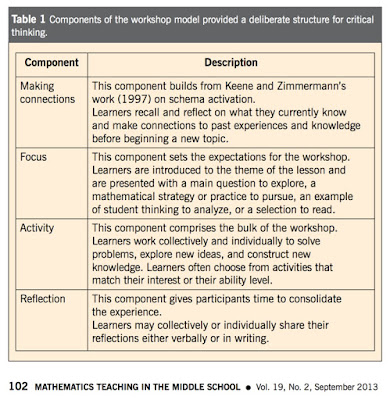
When it came time to develop a framework for the lesson prototype, I returned to a familiar instructional approach: Math Workshop. I wrote about this approach with some GVSU math colleagues in a Mathematics in the Middle School article. Table 1 from the article, shown below, gives a good overview of the Math Workshop Model that we use.
I tend to use "Schema activation" instead of  "Making connections" for the first part of the lesson because of its use in reading workshop - where I was introduced to the approach.

Last year, I shared this method with Kristin Frang. We were working on a project that required designing lessons. I wrote the framework on the board using only the initials:
Kristin said, "If only you had an "I" it could be safari."

Having been on an actual safari (and being a bit obsessive about acronyms), I couldn't believe I had never seen this before. All the framework needed was an "I" to complete the word, safari. 

The "I" became "I want to ..." as a way to recognize the importance of students making their own choice about what to explore in their learning journey. And that's the coolest thing about SAFARI lesson design - in Swahili, safari literally means travel or journey.

With the framework developed, the next thing to do was create a process for using the framework to design the lesson prototypes. I wanted to stay true to Design Thinking and use a process that would foster innovation. So in the next post, we will explore Carousel Lesson Design.


Saturday, January 30, 2016

Where was I using the Process Standards?

MTH 110 is an Intermediate Algebra course that explores topics typically found in Algebra I and II. Most of the students have seen the content before but for some reason it did not stick (nobody's fault, just a fact). Instead of simply re-teaching the topics, we are using the content to extend our understanding of what it means to do mathematics.


One of the ways we are attending to the mathematical process is by making our thinking visible is through Metacognitive Memoirs. Because this is a new approach to many of my students, I spend a good portion of Flight School (the first three weeks of the semester) developing the idea of how we can go beyond showing our work. This past week, I facilitated a workshop that demonstrated one way to share our thinking.

Schema Activation: Predict how many small cubes are in Step 43
from Visual Patterns
Focus: NCTM Process Standards
As I share my thinking, please keep track of where I am attending to the bullet points associated with these processes
Activity: Metacognitive Memoir Demonstration


Reflection: Where was I ...
  • Problem Solving
  • Reasoning
  • Communicating
  • Connecting
  • Representing
It might help to see my notes.
Please share your thinking (where I made the processes visible and opportunities I missed or messed up) in the comments.

Friday, October 31, 2014

Will it fit?

I used this lesson in MTH 221 (Mathematics for Elementary Teachers) to address Common Core State Standard 7.G.B.4. It seems to have a lot of potential, but there are still some elements that I think need to be tightened up. These are written in red - along with some other thoughts. I would appreciate any feedback on how to improve this lesson.

[Schema Activation]
How many of you know your fitted hat size? For example, I wear a seven-and-seven-eighths. Today, you are going to find your hat size and what that number means. 
I like the DC cap for a couple of reasons. First, obviously, DC are my initials. Second, it foreshadows the circumference and diameter relationship we will explore in the lesson.

In the past, I have had students measure a bunch of circles to find the ratio between circumference and diameter. It has been a struggle to make it an interesting lesson. This connection to something personal (hat size) seemed like it might be an improvement.

According to LIDS.com, there are a couple of ways to determine your hat size.


We will use both a flexible tape measure and their printable ruler in order to...

[Focus]
... consider the following questions:
  • How are hat sizes and head-measures related? (In other words, if we didn't have access to their table, can we determine a hat size given a head-measure?)
  • We are supposed to be working on CCSSM 7.G.B.4. Is this connected in some way to circles? Too obvious?
  • Why don't hat makers just use the head-measurement as the size?
[Activity]
Measure your head using both the flexible tape measure and the printable ruler.

Feel free to wear the printable ruler as a stylish headband as you work. Optional

Place both your head-measure and hat size on a sticky note and place it at the proper coordinates on our graph.

What does our graph show? Is there a relationship? If so, what do you predict the relationship to be? (If we input 22 inches for head-measurement, what hat size is the output? What if we input C inches?)

Here are a couple of tables for hat sizes from Lids.com. Let's use them to see if we can determine the input-output rule they are using to find hat size from head-measurement. 

There are other hat size tables (for example), but I like that this one makes 22 inches a hat size of 7 because 22/7 is often used as an approximation of pi.

[Reflection]

What did you find? What is the rule?

Des found the following: y = 0.333x - 0.333. Does it work for our table? If it's correct then what hat size does a person need for a head-measurement of 24?

Okay, I wanted to play with the new Desmos linear regression feature - sue me. Is it a problem that this line doesn't go through the origin? That the slope actually represent an approximation of 1/pi? During the lesson, it seemed like this portion required a lot of scaffolding.

So what does the hat size mean? Let's take our headband and place it on the table. Notice that it is nearly the same shape as a circle. Now measure the distance (diameter) across your headband (circle).

In my case, if I measure what is approximately the diameter of my headband, I find the length is close to my hat size (seven-and-seven-eighths). How about you? What does that suggest our hat size means?

The students were most impressed by this portion of the reflection. They liked that the hat size number was not some arbitrary value - that it was actually connected to something mathematical. I looked for some history of hat sizes to explain why this value is used instead of circumference, but Google failed me.

Now what fitted hat size should I buy from Lids.com if my head measure is 24 inches? Seven-and-two-thirds doesn't look like it's an option.

In an earlier unit, students struggled with the idea of independent and dependent variables and creating graphs that accurately represent a real-life situation. Because a hat maker does not make all possible diameters, we decided it didn't make sense to connect the dots. Instead, we came up with the graph shown above.

One of the reasons I like this activity is because it does connect with so many other standards, like 6.EE.C.9 and 6.SP.B.4. What do you think? Does this lesson have merit - is it worth saving? If so, how? Please add your thoughts in the comments.

Updated: As much as I loathe Pi Day, this piece on Stormy Kromers (hats made in the Upper Peninsula of Michigan) might make a nice connection.

Tuesday, April 1, 2014

Do you need some ideas for a sub plan?

The 2014 Annual Meeting & Exposition of the National Council of Teachers of Mathematics (NCTM) is being held in New Orleans this year. I am taking a group of preservice math educators to the conference, as well as co-leading a workshop on Playing with the Common Core with my wife. This means that I (like many other teachers attending a conference that meets during the school-week) will be away for several classes and in need of sub plans. Fortunately, for me, I teach teachers and they have several projects they can work on for the two class periods that I will miss - no sub needed, just plans. But I remember being a middle school math teacher in need of plans that could be "sub-proof" while I was away facilitating professional development at other districts. My favorite activity to assign was "Rewrite the Text."

Now it might be called "Math Book Makeover" in homage to Dan Meyer's TEDxNYED (see below). In fact, there are a lot of things I would change, given what I know now. If you are looking for some sub plans, here is a workshop I might use.

Math Book Makeover Workshop
My thoughts are in blue.

Schema Activation: (Done before I leave) Chair-Pair-Share
  • What would you expect to see in a math book?
  • Which of these things helps you learn math?
  • Are there any things you think are missing?
  • Are there any things you would get rid of and why?
Focus: (Watch before I leave) Math Class Needs a Makeover


We are going to watch a former math teacher talk about some ways we might change math class. I want you to pay particular attention to ideas associated with changing math books and how we might apply these ideas to our textbooks. Please keep a record of these ideas so we can talk about it later.

I know that much of this might go beyond a middle school learner's current level of understanding, but I believe he or she can get a sense of some ideas of things to do to change the text. The goal is to immerse the learner while focusing on what is important.


Whole class discussion: What were some of the ideas you might consider applying to a makeover of our math book?

I hope they will notice that we need to change the text so it:

  • Supports reasoning;
  • Promotes problem solving;
  • Matters; and
  • Incorporates dynamic resources (video, technology, ...)

Activity: (While I am gone) The Makeover

Depending on the number of days I was going to miss, I might assign a section for each day. I know this would probably not be enough time for my learners, but I am in the habit of giving learners too much to do because it forces them to make choices about what is really important to accomplish. For each section, they would need to identify what part of the lesson would go, what would stay, and what they would add. I could require particular features (practice problems, assignments, technology, assessments, rubrics, teacher notes, ...) if it made sense given where my learners were in their understanding of math books.

The level of polish would depend on my audience and purpose. If I am the audience and the purpose is to simply to see how they thought about revising the text, then sticky notes might be all I needed to see. But if the purpose is to really revise the sections and perhaps use some of the ideas with future learners (leaving a legacy - another good TEDxNYED Talk), then I might want something more substantial. This might require giving them more time and feedback. And, if I want to avoid checking their Google Docs at the hotel after attending a day full of sessions, some time in class after I get back.

Reflection: (At the end of each period when I am gone) Glows and Grows
  • Glows: What are the two parts of the revision that you are most proud of and would want to share with others? What makes them so good?
  • Grows: What are the two parts of the revision that you believe still need some work before they are ready to share with others? What work do they need?
These questions put the learners' work into perspective. I can spend more time evaluating the Glows, because they are presumably the best work, and allow for some approximation in the Grows. The learners can also use this reflection to make a plan for what comes next.

=====

If you are looking for sub plan ideas, I hope this helps. As a middle school teacher, one of the reasons I liked this plan was because it was so adaptable to whatever content we were currently exploring. I did not need a special project that addressed some specific content. I could also avoid using a plan that was disconnected from our current work. It seemed like an approach that could be used with any section in any middle or high school text.

So what do you think? Would a workshop like this work as a sub plan for you? Why or why not? Please leave your thoughts in the comments.

P.S. If this doesn't work for you, then check out these sub plan ideas from Julie Reulbach.

Wednesday, February 12, 2014

How are you getting this kid to the next step?


This semester I am teaching two sections of Mathematics for Elementary Teachers II. In an effort to prepare these future teachers to be educational leaders, I am asking them to lead professional development sessions around Kassia Omohundro Wedekind's book, Math Exchanges. Groups of three or four teachers are taking turns developing and facilitating activities and leading discussions related to one of the chapters. I have been impressed with their efforts and wanted to share an example from chapter three: Planning with a Purpose. (Groups are using a workshop format to plan their professional development sessions.)


Schema Activation (10 minutes): Main Ideas
What quotes or big ideas stuck out to you throughout chapter three?

Focus (15 minutes): Workshops
What math workshop did you like the most?
What common ideas did you see throughout the workshops?
What foundational concepts were touched on?

Activity (20 minutes): Creating Student-focused curriculum
Ben has 10 cookies to share between his two friends, Hailey and Anna. How many cookies will each friend get? (p. 52)
With your student (based on their specific characteristics) develop ideas with your group of how you could adjust your math exchange for this particular student.

(Groups were given a list of characteristics and a sheet of easel paper. They were asked to use these to create a poster of their adjustments to present to the class. Below are the characteristics and the final posters.)

Jose
  • Easily frustrated
  • Helps when he draws the problem out
  • Counts on fingers


Ariana
  • Very shy, keeps to herself
  • Afraid to ask for help
  • Observes others while they work
  • Likes using the manipulative kits


Bridgett
  • Confident, fast worker
  • Doesn't remember how she got her answer
  • Often works too fast and doesn't get right answer


Jack
  • Verbal in a group setting
  • Second guesses himself
  • Knows material but needs help getting started


Reflection (15 minutes): Class Discussion
How can you use what you learned from specializing your lesson to help you in your classroom?
What are some things you noticed about math exchanges?
(be sure to highlight the following)
  • no two math exchanges are the same
  • always adjust the math exchange for YOUR students
[note: some small edits were made to the plan before posting to this blog]

Tuesday, October 15, 2013

What's wrong?


  • Make sense of problems and persevere in solving them
  • Construct viable arguments and critique the reasoning of others
  • Attend to precision
These are three of the eight Practice Standards associated with the process of doing math that will now be assessed in states that have adopted the CCSS. Some teachers I have talked to are concerned about how they will incorporate the Practices in their math classes. I decided to share an activity that addresses these three Standards and can be adapted to nearly any content - a Crit Session.

I first heard of Crit Sessions while reading Jonah Lehrer's Imagine. Despite the controversy surrounding this book, I found his description of the Crit Sessions held at Pixar to be particularly interesting and began to consider how to apply this idea in my classes. So I developed the following workshop.

+++++

Crit Session for Presentations of Mathematical Thinking
This can be used for any content where students, individually or in groups, are presenting mathematics. The work does not need to be completely thought out. In fact, it helps if the work is "in progress" as the feedback provided by peers can help the students to move forward.

Schema Activation [5 minutes]: Review the information you want to share.

Focus [5 minutes]: What is a Crit Session?
Read the following edited extract from Imagine:

Concentrate on the second paragraph:
  • Learning from other people's mistakes
  • Distributed responsibility for everyone's success
Activity [40 minutes - assuming 4 group presentations]: Crit Sessions
  • 5 minute presentation
  • 5 minutes for feedback
    • Critical groups (audience) take a minute to organize critiques
    • Members of the presentation group splits up to meet with critical groups - this makes the critiques more manageable and seem less harsh than in the whole class setting
Reflection [10 minutes]: What; So What; and Now What?
Back in presentation groups, after everyone has presented, the members share:
  • What feedback did we hear?
  • So what made the feedback important?
  • Now what should we work on?
The information does not necessarily need to focus on their own presentation since we sometime learn from other people's mistakes.

+++++

The students I have tried these Crit Sessions with have been positive about the approach. They appreciate the permission to be critical (critique the reasoning of others). Most times they feel as though they have to be nice, non-critical, in order to have a safe classroom environment. Yet, no one felt attacked or belittled and the classroom community seemed even stronger after the workshop. After all, they were working toward a common goal - success.

I am also impressed with how these Crit Sessions have supported a growth mindset in regards to doing math. The students seem more attuned to the need to put effort into working toward precision in their work and the work of their peers. Also, there is a built in expectation that they will need to make improvements (persevere) to their work. No one expects to get it entirely right the first time.

If you try this approach in your class, please share your efforts and any adaptions you needed to make in the comments. Thanks!

Friday, August 30, 2013

What if it's boring?

Engagement Rubric
It is the first week of the semester at GVSU and we have been focusing on engagement in my math courses for preservice elementary teachers. There are two big take-aways I hope my learners get from this week: (1) An awareness of what engagement really means (this is an old version of the activity that needs updating); and (2) An acceptance that they are ultimately responsible for their own engagement in the learning process. Given the conventional wisdom that engagement looks like compliance and that it is the teacher's responsibility to engage students, addressing these points takes effort - hence a week's worth of lessons. (Stephen Carroll at Santa Clara University calls this Flight School in his classes, and his lasts for two weeks.)

So we spend time identifying what engagement looks like for us - because it is personal. We also discuss how outside influences (Conditions of Learning) can support engagement, but that true engagement resides within the individual. And then I give them time to practice engaging with information that might not be all that interesting to them. (Please do not misunderstand. I am not suggesting Daniel Pink's TED Talk is boring. It's just disconnected from what many of my students expect in a math class for elementary teachers.)

Here's the home workshop:

Teaching Workshop (The Puzzle of Motivation)
How does this apply to education

TLW apply the engagement strategy of asking questions while watching a lecture.

Needs:            40 minutes; access to Internet; & journal

Schema Activation:  Journal Jot       [no more than five minutes]
How are engagement and motivation related?
What role does motivation play in education?

Focus: Asking Questions       [no more than five minutes]
The first day of class, we found out how engaging it can be to ask the questions that drive the delivery of information. However, we do not always have that option. For example, when we are watching a video of a lecture there is no way to interact directly with the speaker.

Yet, questions can still be a powerful tool. Perhaps it will help if we try to engage in the lecture by considering what questions the speaker is answering. Even better, we can watch the lecture with a question in mind and try to find answers in what the speaker shares.

So, as you watch the following TED Talk:
  • Make a list of the questions Daniel Pink might be answering; and
  • Keep this question in mind: How does this apply to education?
Activity: Engaging with a Lecture            [no more than twenty-five minutes]


Reflection:  Monitoring Our Engagement   [Remaining part of the 40 minutes]
Using the Extended Engagement Continuum (modified from Morgan and Saxton, 2006) shown below, evaluate where you were as you watched the video, why you were at this level, and what you can do next time to increase or maintain (if you are at #8) that level of engagement.
  1. Disengaged: distracted by other things while doing the task;
  2. Compliant: completed the task but didn’t get much else out of it;
  3. Interest: being curious about what is presented;
  4. Engaging: wanting to be, and being involved in the task;
  5. Committing: developing a sense of responsibility towards the task;
  6. Internalizing: merging objective concepts (the task or what is to be learned) with subjective experience (what is already owned) resulting in understanding and therefore ownership, of new ideas;
  7. Interpreting: wanting and needing to communicate that understanding to others;
  8. Evaluating: wanting and being willing to put that understanding to the test.
How did focusing on questions help (or not help) you engage with the lecture?

+++++

A final thought for the teachers reading this post: Your students may not always have teachers that are as worried as you are about student-engagement. How are you preparing them to be successful in those other classes - to recognize they have the power to be engaged regardless of the situation. I offer one approach. I would be interested in your ideas.

TEDxGrandValley