Monday, January 20, 2014

Not so easy, is it?

Deborah Ball, Dean of the University of Michigan's School of Education, chairs the Michigan Council for Educator Effectiveness (MCEE) which was tasked to make recommendations to the Legislature about teacher evaluation. As part of her testimony before a joint meeting of the House and Senate Education Committees, she took some time to make the point that the work of teaching is often misunderstood and harder than most non-educators imagine.

The example she gives comes from fourth grade mathematics - multiplying two two-digit numbers (4.NBT.B.5). First, the teacher must be competent in the content. For example, what is the product of 49 and 25?

From Dr. Ball:
Obviously one wouldn't want anyone teaching third or fourth grade who couldn't do that. But, in fact, what skilled teaching involves is responding when students don't understand the material...
Knowing the mathematics is not enough. Teaching requires more than simply marking students' answers right or wrong. To be effective, teachers must be able to diagnose students' misconceptions in order to provide the support necessary for students to develop mathematically. Dr. Ball provides three examples of possible errors teachers might encounter from students multiplying 49 and 25:


When she asks the legislators how the students might have arrived at these answers, ... watch for yourself (it starts at about 2:30).


Dr. Ball does an effective job of pointing out that teaching is more than knowing and sharing content. However, this example focuses almost entirely on the "upper-half" of the Teaching-Learning Cycle: Assessment and Evaluation. Developing a plan for addressing the student-misconceptions and implementing that plan with a class of fourth graders raises the level of difficulty even higher. I hope these lawmakers now understand that there is more to teaching than what they experienced from the student-side of the desk.


Saturday, January 18, 2014

Why would you want to teach?

While teachers in America often come from the bottom of the academic barrel...
This quote is from a U.S. News piece reporting on a talk Secretary of Education, Arne Duncan, gave to a group of parent leaders. While Secretary Duncan is not responsible for the above quote, he did say:
Both South Korean and U.S. citizens believe that the caliber of teacher matters tremendously, and the great teachers make a huge difference in children's lives. The difference is: they act on their belief. We don't. We talk the talk, and they walk the walk.
Unfortunately, the first quote ignores the reality of the situation (see these excellent pieces from Jeff McQuillian and Matthew Di Carlo) and Duncan's  words minimizes the great teachers already in the profession and efforts to improve the practice currently underway. The problem is, the talk does impact the walk (or at least those who might take the walk).


In 1985, I graduated from Pepperdine University with a degree in Mathematics and Computer Science. I had earned a 4.0 GPA, was the Valedictorian, and could have made a bundle as a programmer. But I had done some tutoring and coaching during my four years in Malibu and made the decision to become a teacher instead.

Because both my parents were teachers, I knew what was ahead. I had seen firsthand how hard they worked outside the school day to be "great teachers" that made "a huge difference in children's lives." At Mom's funeral, a line of former students and parents came up to us to recognize her efforts. I was also aware of the teacher-bashing going on at the time. Comments like, "Those who can do. Those who can't teach." The vitriol was bad enough that my parents steered me away from education, although later Mom admitted she knew I'd be a great teacher.

When I shared with some of my former middle school and high school teachers that I was going to go back and get my teaching credentials, I was surprised by one person's response. "Why would you want to teach? With your grades and degree, you could do anything." Evidently, things were so bad in education, anything was better than teaching. I stuck with it, though. Probably because I saw how much my parents loved their jobs and cared about their students.

Not everyone does stick with it, however, and the number of people interested in becoming a teacher is decreasing. Why? Maybe because teachers continue to be unfairly maligned and scapegoated by educational authorities. Perhaps Secretary Duncan thinks this sort of rhetoric is going to bring in great teachers. My guess is it's more likely to result in more people asking great teachers and college students who would make great teacher the question: Why would you want to teach?


Saturday, January 11, 2014

How would you describe someone successful at math?

I try to start each semester with some activity that brings to light my preservice teachers' beliefs about mathematics. This typically entails using a modified version of a Simile Survey used in my doctoral work, but last August I attended a session at the Michigan Council of Teachers of Mathematics Conference that introduced me to some new tools. This is one of the tasks that Shannon Sweeny shared with us during the session:
Shannon gave me permission to use this instrument in my teacher preparation  courses, and I combined it with an article from Educational Leadership to create a productive workshop that got at beliefs about success in mathematics.

The teachers picked the five words their "elementary-self" would have chosen to describe someone who was successful at math. Then I asked that they write out the experiences they had during elementary math lessons that might have contributed to their choice of words. Next, I had them read the first part of the article, Afraid of Looking Dumb, that includes the following exchange between the author and a second grade student, Brenda.

Brenda: I feel like I'm not good in math, and I get scared. I feel like I'm the dumbest in the class in math.  
Me: In just math or other things, too? 
Brenda: Other things, too. 
Me: Why do you feel that way? 
Brenda: I can't do as much as other people. 
Me: When you start math, what do you tell yourself? 
Brenda: I can't do it. I'm scared. 
Me: What if you couldn't do it? 
Brenda: I wouldn't be smart in that subject. I should be able to do it. I'm scared that people will tease me. 
Me: What would it look like if you were smart? 
Brenda: I'd be a fast thinker, quick learner. The first time I try things, I'd get it right. 
Me: What do you tell yourself when I tell you that you're better than you think in math? 
Brenda: I don't believe you. 
Me: Do you want to change? 
Brenda: Yes, but how? How are we going to change our thinking? 
I asked the teachers to: (1) predict the five words Brenda might have selected regarding success; (2) identify the evidence in the dialogue that supports their choices; and (3) infer what experiences Brenda might have had that fostered her beliefs. As an example, I said, "I think Brenda might pick 'arrogant' because of the line, 'I'm scared that people will tease me.' This might be the result of having experiences where kids or teachers teased her or her peers when they made math mistakes." A fair number of the teachers remarked that they thought Brenda would have picked a lot of the same words as their "elementary-self." Consequently, in predicting the experiences that might have contributed to Brenda's view, many shared their own experiences in elementary math classes as possible reasons for Brenda's perspective.

This awareness that not much has changed in the teaching math since they were elementary students is an important step if we are going to begin doing things differently. I told them that I do not want to be having this same conversation with their students when they get to my class in 20 years. Don't get me wrong, it's an interesting discussion, but the semester would get off to a better start if everyone entered class believing they could be successful in math.

Tuesday, December 31, 2013

How can we pass the time?

For the past three year, we have spent New Year's Eve at the Wealthy Theater in Grand Rapids listening to Michigan supergroup, Starlight Six. They usually play three sets of music, with short intermissions between sets. During one of the breaks last year, I was looking for something to do (trying to find a problem to play with) when I noticed the light string at the back of the stage.


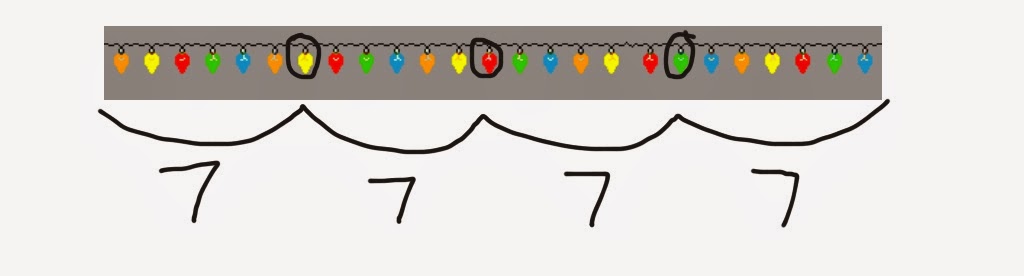
The string of 25 lights were hung in a way that I could see two groups of 13. 
This seemed quite appropriate given that it was 2013. And it got me wondering about what other groupings I might make with this string of lights.

I imagined using two interior anchor points (adding two more lights) in order to create three groups with nine in each group.
Making four groups meant adding three more lights. With 28 lights, each of these groups would have seven lights.
Five groups created a problem. When the four anchor lights, which were being double counted, were added to the original 25, I had a number that was not divisible by five. But six groups, with 25 (original) + 5 (anchor) lights, resulted in five lights per group. It had me wondering if other strings would be as "friendly" to various groupings or if there was something special about 25.

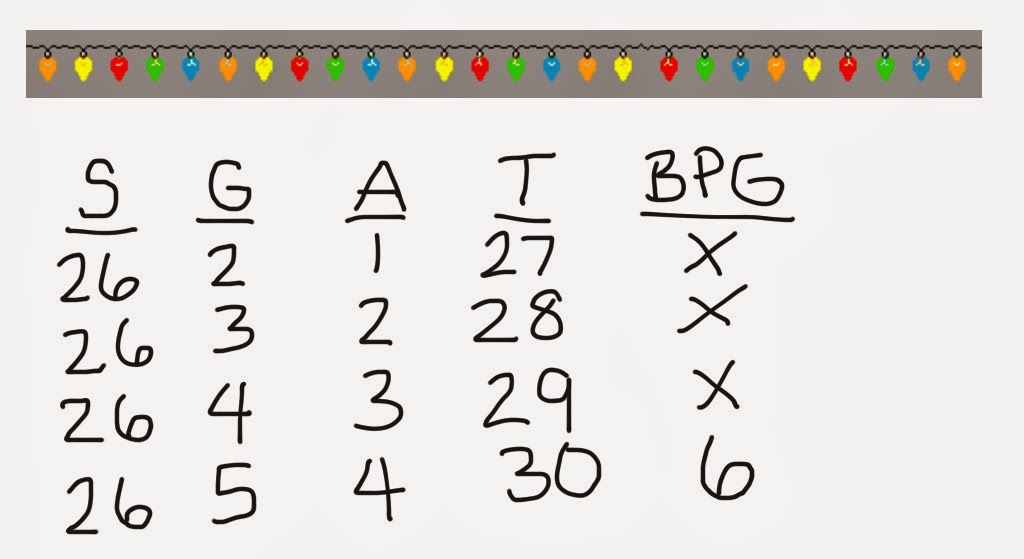
So I thought about a string of 26 lights. Two groups added one anchor resulting in 27 total, which is not divisible by two. Three groups added two anchors resulting in 28 total, which is not divisible by three. Four groups also didn't work. But five groups added four anchors for 30 total, and 30 is divisible by five - resulting in 6 bulbs per group.

This still left a lot of questions to explore. But the band was back on stage, so I filed this found problem away for another time.


Feel free to use it as a way to pass the time this coming year. Or better yet, find your own problem.

Thursday, December 19, 2013

Why does this bother me?

First, because some of my students check in on this blog, I want to be clear that the thoughts presented here represent my own issues and are not meant to shame my students or dismiss their perspective. Second, for my 200th post, I thought I would share one of my issues with you. So, consider yourself warned.

Near the end of the semester, I often ask students to reflect on the course and write a letter advising future students on what to expect. (I wrote about it here.) This time, I asked them to narrow it down to three important points. One student wrote:

"This is an education class not a math class."

For some reason, this point really bothered me. I do not know how my student intended it (and it doesn't matter - this is about me), but I took it negatively. One of the ways I can tell I have had a button pushed is when I start getting defensive. So when I began to line up all my arguments, like soldiers on a battlefield, in order to attack this point, I knew that it was time to take a step back and consider why I was uncomfortable with this point.

It did not come to me immediately, but then yesterday I read these Tweets, 
and the linked articles (here and here, respectively). Both use reports from the National Council on Teacher Quality (NCTQ) to reinforce the narrative that U.S. efforts to train teachers are "abysmal." Yes, I know that the NCTQ teacher prep rankings are non-sense (none other than Linda Darling-Hammond makes the case) but I seem to have bought into the non-sense. Therefore, when the student wrote that my course was an "education class," I began to worry that I was part of the problem.

Most teachers can probably understand this line of thinking. Regardless of what we know about the realities of education, the message seems to be that teachers in the U.S. are to blame for all of our educational ills, whether real or imagined. Therefore, I want to do all I can to "make things better" - even if it is unwarranted.

A friend of mine once told me that if my buttons were being pushed, then I needed to move my buttons. In this case, I needed to shift my attention to aspects of the course that were preparing these future teachers for the realities of the profession; this was, after all the overarching goal of the course.

Please pardon me if this next piece seems self-serving, but I need to acknowledge some of the points other students shared:
  • Keep up with the readings! They are very important towards your teaching future.
  • As future teachers you understand that the main goal is helping the students learn. That is your professor's goal as well!
  • You will work extensively in collaboration with your peers, as you will as future classroom teachers.
  • Do not procrastinate! Otherwise you will have an overwhelming amount of work to do.
  • Put a ton of effort into this class even though a lot of the things that you do won't be graded because you will get out what you put into the class.
  • Take time to reflect on different aspects of class because there is a lot of useful information, and you want to be sure you have learned most, if not all, of it.
Reviewing these, there does seem to be a lack of attention to the mathematical content; this is something to consider for next time. However, as education classes go, I am satisfied that this course provided students with some of the tools necessary for success in teaching: reading research, focusing on learning, being prepared, giving less attention to grades and more on learning, and recognizing the importance of reflection. 

Friday, December 13, 2013

Finals! Huh! Yeah! What are they good for?

We just finished finals at Grand Valley. Coincidentally, this week of exams overlapped with the release of the second Hobbit movie; this might explain why these lines (modified from this poem) were going through my head Thursday as I walked around campus:


I am not trying to suggest that like the One Ring, final exams are evil and must be destroyed. However, I do wonder about the wisdom and unintended consequences from placing so much emphasis on a single assessment event.  Rarely do final exam scores make that much of a difference on final grades. Yet, there is so much stress associated with final exams, for both the students and the teachers, that it got me to wondering if these tests are worth it.

During the MTH 323 final event (we did not have a written exam), I asked the teachers to consider whether or not our school ought to have final exams and why. This is the course for preservice teachers that I designed to reflect what it looks like to be a math teacher in a K-8 school. So we created a "school" and went about developing a curriculum. Therefore, it seemed reasonable to discuss the final exam policy we would have at our school.

Grade-level groups talked about the question and then shared their thoughts and rationale. I added my two cents, but mostly these points represent the teachers' perspective.
  • We need to have some sort of culminating experience as a way to identify what a student has mastered and possible weaknesses in the curriculum.
  • The experience needs to be different than the traditional exams that represent a cram and purge approach that does not result in lasting learning.
  • Like it or not, exams are a part of our culture and we would be doing our students a disservice if we fail to provide some experience with these types of assessments.
  • Perhaps we could give the exams a couple of weeks before the end of the semester so those who need to can make revisions and the rest can extend their learning.
  • Whatever we have them do needs to be meaningful.

It was the last point that resonated with me. How do we ensure that the culminating experience is meaningful - that it fosters the upper levels of the Engagement Continuum and not just compliance?
Developed by MTH 323 Teachers to monitor their engagement
Based on Engagement Taxonomy of Morgan and Saxton
At breakfast this morning, I asked a colleague what he thought final exams were good for. He said, "To see if students have synthesized the information addressed in the course." After a pause, he continued, "Of course, those are the questions they often struggle on most, which is discouraging."

"Why do we give all the other questions, then? The ones that focus on recall. Why not focus on the synthesis questions?" I asked.

"Probably because it's what we've always done," he responded. Neither of us were satisfied with this answer, but finals week was over (it was, after all, final) so there was nothing we could do about it now except think about what we might do different the next time around.

Tuesday, December 10, 2013

How does it fit?

At the beginning of the semester, I wrote a post about using the history of the LEGO company as a cautionary tale for innovation in education reform. The idea came from a Diane Rhem interview with the author of Brick by Brick. But there was another idea presented in book that also caught my attention - clutch power.
When a child snaps two bricks together, they stick with a satisfying click. And they stay stuck until the child uncouples them with a gratifying tug. And therein lies the LEGO brick's magic. Because bricks resists coming apart, kids could build from the bottom up, making their creations as simple or complicated as they wanted. … it is clutch power that makes LEGO such an endlessly expandable toy, one that lets kids build whatever they imagine. (page 20)
It was the last sentence that got me thinking. How might I design learning experiences that use clutch power - allowing learners to "build whatever they imagine?" In particular, I had one of our math courses for preservice teachers in mind. It explores a variety of mathematical topics that students often see as disconnected: algebra, geometry, measurement, and data.  Was there a way to treat concepts in that course as building blocks that learners could use across the domains to build new understandings instead of simply following the instructions I provide?

I am still working on that question, but I did start experimenting with simple problems that allow learners to add their own ideas while demonstrating their content competency. The following is one problem (modified) from the final I just gave. I would be interested in your feedback.


Plot the points (2, 2) and (2, 4) on the coordinate plane. Pick two other points that could combine with these first two to be used as the vertices of a trapezoid. Use this context to develop items that would align with the following targets (be sure to justify your alignment using the indicators):

  • Graph points on the coordinate plane to solve real-world and mathematical problems (5GA1, 5GA2)
  • Classify two-dimensional figures into categories based on their properties (5GB3, 5GB4)
  • Solve real-world and mathematical problems involving area, surface area, and volume (6GA1-A4)
  • Draw, construct, and describe geometrical figures and describe the relationships between them (7GA1, 7GA2, 7GA3)
  • Solve real-life and mathematical problems involving angle measure, area, surface area, & volume (7GB4, 7GB5, 7GB6)


Because this was a new assessment for most of my students, this time around I offered some example items to pick from:
  1. Define the term "trapezoid" and then use that definition to identify what other names apply to your shape.
  2. Find the area and perimeter of your shape.
  3. Extend each side (creating 16 angles) and find all the angle measures.
  4. Write your own question for this context.
I still expected them to align the item with the targets, justify their alignment, and come up with a correct response.

TEDxGrandValley