Showing posts with label Holiday Math. Show all posts

Thursday, December 14, 2017

And then what did you do?

In my experience, middle school students are often reluctant to try a problem they don't already know how to solve and uninterested in using alternative solution methods once they have one that works. Some middle school math teachers I worked with this week have found the same thing. So we considered how we might use techniques from improv to help students get started on a problem and possibly explore an approach they might not normally use. Improv techniques like the "Yes, And..." activity.


We decided to play it using this situation from Context for Learning Mathematics [CFLM] and a couple of starting choices.


Starting Steps:
1) First, I split up the dollar and the 25 cents and multiplied the dollar by 24.

2) First I doubled $1.25 and got $2.50.

We would make teams of three. Two people would engage in the "Yes, And..." activity while the third kept "numeric notes" that could be referred to after the activity. 

Here's how it might work:

Numeric Notes
First, I split up the dollar and the 25 cents and multiplied the dollar by 24.

Yes, and then I added back the 25 cents and got $24.25.

Yes, and then I remembered there were 23 more quarters that I need add.

Yes, and I don't know what 23x.25 is so I did a quarter plus a quarter is a half dollar instead.

Yes, and that reminded me that there are four quarters in a dollar.

Yes, and that made me wonder about how many dollars there are in 24 quarters.

Yes, and I divided 24 by 4 and got 6.

Yes, and that means 24 times .25 is 6 dollars.

Yes, and then I added 6 dollars to the original 24 dollars.

Yes, and that means the total cost of the turkey is $30.

Afterwards, the students reflect on the activity. This is an opportunity to observe their own thinking: what they did; why they did it; and how else they might have navigated the situation. I have done something similar with my college students, who finish up by writing a Metacognive Memoir about their experience.

Thursday, December 4, 2014

Where's the math?

In this final post on the Five Practices, we look at the final Practice - Connecting. Previous posts from this series explore preservice elementary teachers work on Anticipating, Monitoring, Selecting, and Sequencing related to this lesson from Context for Learning Mathematics (CFLM - Fosnot et. al.). Because elementary children are in short supply at our university, the future educators use professional development materials gathered from a third-grade classroom working on the turkey-cost problem as a substitute.


Image used with permission of authors 
New Perspectives on Learning
In this part of the exploration, my teachers watch video of the third-grade teacher wrapping up the lesson. They look for evidence of the teacher Connecting (1) the various approaches used by the students, (2) key mathematical ideas, and (3) a new, related problem. Connections between the students' approaches are especially strong given choices she made in Selecting and Sequencing the work to share. 

The transition to the next problem also seems well-thought-out as students determine how long to cook the 24-pound turkey if the cookbook suggest 15 minutes per pound.
Image used with permission of authors 
New Perspectives on Learning
The connection to the turkey-cost problem is obvious to the teachers.

The part of the Connecting sequence that seems most lacking is Connecting the students' work to key mathematical ideas. I try to make it clear that it is unfair to criticize the teacher because we do not know what happened before or after the lesson or, for that matter, other contextual factors that might have influenced her instructional decision making. However, to ensure that the teachers recognize the big ideas associated with the different approaches, I offer the following additions to the lesson.

The first three students are applying the Distributive property to the cost per pound decomposed into it's whole number and decimal parts. In order to compute 24x0.25, the students are essentially factoring 24 into 6x4 (4 being the multiplicative inverse of a quarter, 0.25) and then using the Associative property to regroup the order of multiplication. Consequently, the original expression, 24x1.25, simplifies to 24+6 or $30 - the answer to the turkey-cost problem.


The last pair of students used a more efficient approach that bypassed the need for the Distributive property. They still factored 24 into 6x4, but then they used the Associative property to multiply 4x1.25 first, to get 5, and then 6x5. Again, the answer is $30.


While some of the teachers think the key mathematical ideas presented in these series of expressions might be beyond the third-graders' current understanding, the Associative and Distributive properties are found in the Grade 3 Common Core State Standards (3.OA.B.5).

What do you think? Is this too much to expect of third-graders? Do you have another way that these key ideas might be connected to the students' work?


Friday, November 28, 2014

How did the teacher organize the turkey-cost discussion?

My preservice teachers have reached stage four, Sequencing, of the Five Practices (see previous posts for Anticipating, Monitoring, and Selecting). Because these teachers have no direct experience facilitating a discussion involving students reflecting on their mathematical thinking, we return to the third-grade class and watch a video of how the teacher Sequences the work of the students on the turkey-cost problem. I ask the future educators to watch the consolidating conversation and hypothesize why the teacher decided to order the student-work the way she did.
=====
All images are from New Perspectives on Learning
used with the permission of the authors


Emma and Emma take the $1.25/pound price and start with a friendlier number - $1 per pound. If that were the price, then the 24 pound turkey would cost $24. But they recognize they need another twenty-four $0.25 to find the total costs. So they count by 25s, keeping track of how many 25s they have counted underneath. They find they need another $6 for a total cost of $30.


Harry and Ese use a similar strategy of breaking the price per pound into a dollar and a quarter. However, instead of counting by 25s, they gather the quarters in groups of four. Each group of four quarters is a dollar. There are six groups. Therefore, $6 must be added to $24 to get the total cost of $30.


The next pair, Nellie and Nate, also start by taking off the 25 cents to get an initial cost of $24. Then they group the quarters, but they do it differently than Harry and Ese. Instead of showing "pictures" of quarters, they use a table to represent the relationship between pounds and dollars at $0.25 per pound. The table shows that 24 pounds requires an extra $6. Again, the total cost is $30.


Finally, Suzanne and Rose share a unique strategy that does not break up the $1.25. They know that "4 pounds is 5.00" and use this to jump by 5s on the open number line. There are six jumps because there are six 4s in 24 pounds. Although they use a different approach, Suzanne and Rose also find the cost to be "30 $ in all!"


=====
After observing the Sequence of approaches, the preservice teachers offer their hypotheses about why the teacher put the student-work in this particular order. Some suggest it might have progressed from "most popular" to "most unique." Others think it was based on increasingly sophisticated structures. A few wonder if it might be related to the different representations being used.

Why do you think the teacher ordered the work in this way? And where do you think the teacher goes next to complete the last Five Practices stage, Connecting? As always, your participation in the comments is appreciated.

Wednesday, November 26, 2014

Who should share their turkey-cost solutions?

All images are from New Perspectives on Learning
used with the permission of the authors
In preparing future educators to facilitate productive math lessons, we provide opportunities for them to apply the Five Practices to problems like the one shown here. Teachers began (in the first post of this series) by identifying a Standards for Mathematical Practice (SMP) to focus on and Anticipating student solution strategies related to this SMP. Next (in the second post), they watched video of third-graders solving the problem in order to Monitor their efforts and compare them to the Anticipated responses. The teachers were also given copies of the students' work to examine. Teachers use this work to begin the process of Selecting who might share during a whole class discussion.

For example, the teachers focusing on SMP 5 might Select these students to share because they all used the open number line as a tool.
The discussion could revolve around how this tool was used appropriately and strategically.

Another group of teachers, focusing on precision could Select the work of the third-graders shown below since they seemed to arrive at different answers.
The class could work together to determine what question each pair of students was answering and how to move toward a correct solution.

Finally, teachers wanting to focus on structure might Select these four student-pairs.
This work included different ways students used the structure of money (decimals) to arrive at a solution.

By strategically Selecting student work to share, a teacher does not leave the  ensuing discussion to the vagaries of volunteers. Consequently, the resulting classroom conversations becomes more purposeful and productive. But first, the teacher must apply another of the Five Practices - number four, Sequencing

How might a teacher organize the Selected student-work for each SMP in order to maximum learning and why?

Tuesday, November 25, 2014

How did those third-graders determine the turkey's cost?

All images are from New Perspectives on Learning
used with the permission of the authors
Having anticipated third-graders' thinking for the scenario provided above (the first of the Five Practices which was attended to in the first post in this series), my preservice elementary teachers are ready to engage in the next Practice - Monitoring students' thinking. Unfortunately, the university has yet to meet my request for a lab school which means that elementary-aged children are in short supply in my classroom. Given my desire to create as authentic experience as possible for my teachers, this creates a problem.

Luckily, Dr. Catherine Fosnot and her colleagues have gathered classroom videos and student-work from elementary kids working on problems from their Context for Learning Mathematics (Fosnot et. al.) series (including from the turkey cost lesson). While it's not the same as monitoring actual students, it does represent the same experiences inservice teachers might have in Professional Development (PD) sessions using Dr. Fosnot's materials.

This PD involves helping teachers to develop phronesis. "Phronesis is situation-specific knowledge related to the context in which it is used—in this case, the process of teaching and learning." (from p. 147 of Young Mathematicians at Work: Constructing Multiplication and Division) By watching the video and examining the students' work, teachers are able to observe an authentic lesson and reflect on the teaching moves that support students who are immersed in doing mathematics.

The preservice teachers in my class watch the video and observe the students finding the turkey cost. Just as many of them predicted, the third-graders are splitting the $1.25 per pound into a dollar and a quarter. Students' papers (like the one on the right) show that they understand the 24-pound turkey will cost $24 plus 24 quarters. Pairs of students use a variety of approaches to determine the total cost of the turkey. As my teachers review the third-graders' efforts, the teachers move toward the next phase of the Five Practices - Selecting students to share their work based on the Standards for Mathematical Practice (SMP) selected at the beginning of this process. 

We will continue this work in the next post. But first, which SMPs would you say the work of Emma and Emma highlights?

Thursday, November 13, 2014

How much is that turkey in the window?

Disclaimer: I receive no financial benefit for my endorsement of the Context for Learning Mathematics (CFLM - Fosnot et. al.) curricula or the associated professional development resources shared in this series.
In my efforts to make my classes for preservice elementary teachers more accurately reflect the work of teachers, I try to craft my lessons as professional development sessions. We spend a significant amount of our time applying the Five Practices for Orchestrating Discussions to activities from established K-6 mathematics curricula. Recently, we used a lesson from CFLM's The Big Dinner unit in anticipation of Thanksgiving.

From Professional Development Resources
used with permission of author
This introductory lesson asks students to find the cost of buying a 24 pound turkey. My teachers start by selecting a Standard for Mathematical Practice (SMP) as a goal for the lesson. (We could also look at content goals, but these teachers need more practice with the SMPs.) Having chosen a goal, the teachers begin applying the First Practice: anticipating possible student responses associated with the goal. The students in this scenario are third graders who are unlikely to use the standard algorithm for multiplying decimals.

Many of the teachers anticipate that the students will break the $1.25 into dollars and cents. For the teachers who identify "Look for and make use of structure" as their SMP goal, this prediction seems reasonable. Some of the teachers consider the models and tools (SMP 4 and 5) students will use to solve the problem. Other teachers, who are attending to precision (SMP 6), wonder where students might make mistakes in their computation. Nearly all the teachers are interested in the different strategies the students will use to solve the problem.

Before we move on to the Second Practice, monitoring students' work, I want to give you an opportunity to add the SMP you would choose to focus on for this problem and possible student responses you might anticipate. As always, please add your contributions to the comments.

In the next post, I will explain how preservice teachers can carry out the remain Practices of Orchestrating Discussions even though they are not actually in an elementary school classroom. 

Tuesday, December 31, 2013

How can we pass the time?

For the past three year, we have spent New Year's Eve at the Wealthy Theater in Grand Rapids listening to Michigan supergroup, Starlight Six. They usually play three sets of music, with short intermissions between sets. During one of the breaks last year, I was looking for something to do (trying to find a problem to play with) when I noticed the light string at the back of the stage.


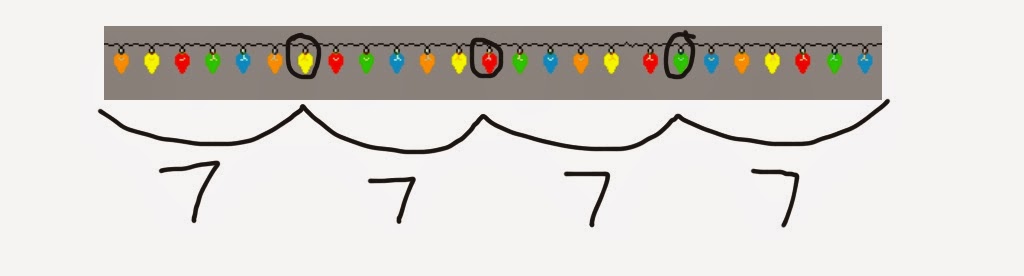
The string of 25 lights were hung in a way that I could see two groups of 13. 
This seemed quite appropriate given that it was 2013. And it got me wondering about what other groupings I might make with this string of lights.

I imagined using two interior anchor points (adding two more lights) in order to create three groups with nine in each group.
Making four groups meant adding three more lights. With 28 lights, each of these groups would have seven lights.
Five groups created a problem. When the four anchor lights, which were being double counted, were added to the original 25, I had a number that was not divisible by five. But six groups, with 25 (original) + 5 (anchor) lights, resulted in five lights per group. It had me wondering if other strings would be as "friendly" to various groupings or if there was something special about 25.

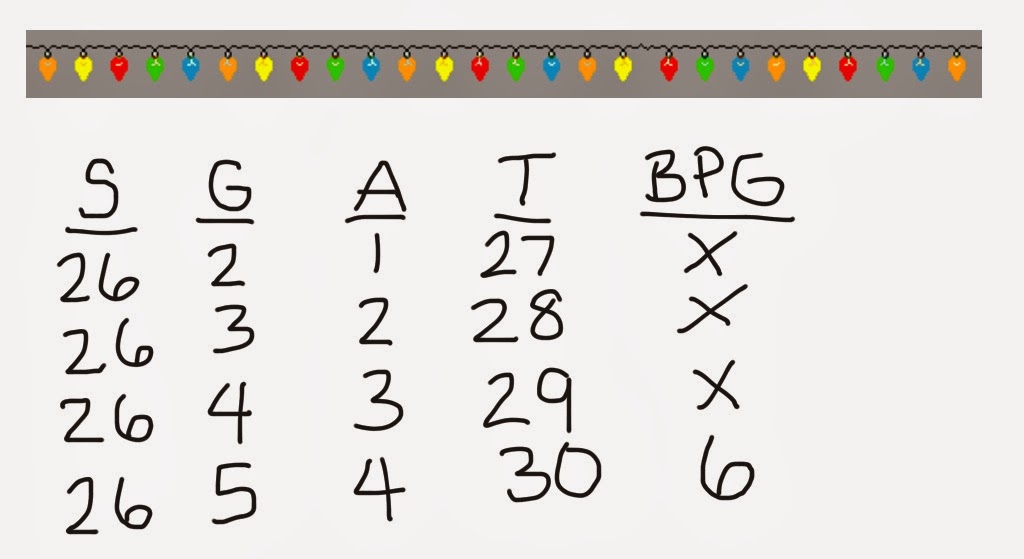
So I thought about a string of 26 lights. Two groups added one anchor resulting in 27 total, which is not divisible by two. Three groups added two anchors resulting in 28 total, which is not divisible by three. Four groups also didn't work. But five groups added four anchors for 30 total, and 30 is divisible by five - resulting in 6 bulbs per group.

This still left a lot of questions to explore. But the band was back on stage, so I filed this found problem away for another time.


Feel free to use it as a way to pass the time this coming year. Or better yet, find your own problem.

Wednesday, December 12, 2012

Did you get anything good?

For years, I have tried to write first semester exams using a holiday theme. Even as a middle school math teacher, I set problems in the North Pole or around different traditions celebrated this time of year. Given a recent #mathchat on holiday mathematics, I thought I would share some of the problems here. Consider it my gift to you. Happy Holidays!

On the twelfth page of the test my teacher gave to me, twelve days of giving.

Use the lyrics from the traditional song, The Twelve Days of Christmas, to complete the table shown below.
Show how you could represent the gifts given each day using simple pictures, a recursive formula, and an explicit formula.


  • How many gifts are given on the 12th day?


  • How many total gifts are given over all 12 days?


On the eleventh page of the test my teacher gave to me, eleven Lions playing.


A while back, WOOD TV8 meteorologist, Bill Steffen, made a claim that the Detroit Lions’ record might be related to the amount of snowfall we get in Grand Rapids.  I emailed him asking for more information and part of his response is shown at the right.

  • The scatterplot below verifies that a positive correlation does seem to exist between the number of Lion wins and Grand Rapids snowfall (based on the data provided).  Draw in an approximate line of best fit and use it to predict the amount of snowfall this season if the Lions win six games this season.


  • By Steffen’s own admission, he “got to pick the years”, which is a factor.  Describe another sampling method that might better represent the relationship between wins and snowfall.

On the tenth page of the test my teacher gave to me, ten snowmen chillin'.

The idea of using snowmen glyphs to represent some of our winter and holiday preferences was introduced here. Recall that if the person making the glyph wears a hat during a typical winter day, then he or she would fill in the snowman's top hat. The same goes for wearing a scarf. Given the 10 snowmen shown below, answer the following questions.

  • What percent of the people represented by these glyphs wear hats on a typical winter day?
  • What percent of the people represented by these glyphs wear scarves on a typical winter day?
  • What percent of the people represented by these glyphs wear hats or scarves on a typical winter day?

On the ninth page of the test my teacher gave to me, nine cookies baking.


As you might suspect, Mrs. Claus is a wonderful baker, especially when it comes to cookies. Her specialty is called Santa’s Hats, which are basically isosceles triangles with red frosting and sliced marshmallows across the bottom and on top. Because so many of the cookies she bakes are for the elves, Mrs. Claus thinks of a batch of cookies in terms of three-quarters of a dozen. If each of these batches takes eleven-and-a-quarter marshmallows, then how many marshmallows are required for a dozen cookies?

On the eighth page of the test my teacher gave to me, eight reindeer playing.

You know Dasher and Dancer and Prancer and Vixen, Comet and Cupid and Donner and Blitzen: But do you recall… what you learned in math class at all?  Use these eight famous reindeer (sorry, no Rudolph) to solve the following problems.
  • Only two reindeer can lead the team.  How many different leading pairs are there (left side and right side does not matter)?
  • You have probably heard about the Reindeer Games. Did you know that they only give ribbons for 1st, 2nd, and 3rd place? How many different ways are there for the three ribbons to be awarded the eight reindeer? (Assume that each reindeer is equally likely to win.)
  • Which of the above questions is a permutation and which is a combination?  Please be sure to explain your rationale.
On the seventh page of the test my teacher gave to me, seven candles burning.

During the week of Kwanzaa, families gather in the evenings to light the candles of the kinara and discuss the Nguzo Saba or seven principles. There are seven candles – three red candles to the right, three green candles to the left, and one black candle in the center of the kinara.

A manufacturer of Kwanzaa candles did some research and found out that the candles do not all burn at the same rate. Below are box-plots representing the number of minutes it took for each candle to burn completely, separated by color (100 candles of each color were tested).


Which candle color seems to last the longest?  Describe how the box-plots support your reasoning.


On the sixth page of the test my teacher gave to me, six bulbs a blinking.

In order to save money this year, Dave decides to buy outdoor bulbs at Ben’s Bargain Bulb Bin.  The bulbs there are cheap, and there are a lot of them (some say an infinite amount), but only three out of every four bulbs work. Dave needs 6 bulbs for the end of each snowflake in a string of lights, but if even one bulb doesn't work, then the entire snowflake remains dark. What are the chances that a snowflake using bulbs from Ben's will be unlit?


On the fifth page of the test my teacher gave to me, five Pecan Puffs.

Just in time for the holidays, a new item has been added to the J. Peterman Candy Collection – Perfect Pecan Puffs. These are five pecan puffs packed in cube-shaped boxes that are arranged to look like a "P" (see ad below) held together using green holiday paper.
The paper is expensive, so Elaine suggests using a "net" to cover the packages. What might this net look like?

PS: Kramer thinks that this is the perfect gift for Festivus!

On the fourth page of the test my teacher gave to me, four lighted trees.

Clark Griswold just purchased The Growing Tree Kit to add to his Christmas light show. Each kit has four, green, foot-high triangles/trees and four strings of red lights that fit around the perimeter of each tree. What makes these trees special is that they stack to make larger trees. Then the string of lights can be put around the perimeter of the larger, combined tree (see the examples below).
Single tree       Combined tree
When Rusty puts together the combined tree, he notices that two of the strings of lights are left over. "That's not a problem," says Clark. "We'll just add them to the roof. What I'm worried about is the visibility of the tree. I think we need to make it bigger - maybe 10-feet tall."

In order to make a 10-foot tree that is mathematically similar to the smaller trees, how many kits does Clark need to buy? Also, how many strings of lights will be needed to light the 10-foot tree's perimeter? What do you notice about the area and perimeter of these similar triangles as they dilate?


On the third page of the test my teacher gave to me, three wise men.
A version of this problem can be found in
Connected Mathematics Project's
Clever Counting

In the story of the Magi, three wise men come from the east looking for the king of the Jews. On their way, they stop at King Herod's for directions. They find out that the Messiah was to be born in Bethlehem. Imagine that the network shown to the right represents the many paths that the wise men could have taken.

  • How many paths were there from the East (E) to King Herod’s Temple (H)? Include only the shortest paths (south/down or west/left).
  • How many paths led from King Herod’s Temple (H) to Bethlehem (B)? Include only the shortest paths.
  • In all, how many shortest paths are there from the East to Bethlehem that pass through King Herod’s Temple? Explain how you arrived at your solution and why it works.

On the second page of the test my teacher gave to me, two types of stools.

From America Trek
In a shed at the North Pole are the parts for 75 stools for the elves in Santa's Workshop. Some of the stools will be three-legged and some will be four-legged (for the bigger elves like Buddy). The shed contains 75 seats and 259 legs. If Santa does not want any parts left over, then how many of each type of stool can be made with these parts? Please use two different representations (pictures, words, symbols, ...) to communicate your thinking.


On the first page of the test my teacher gave to me, a Dreidel with a counting tree.

The Dreidel is an integral part of the celebration of Hanukkah. Children play by spinning a Dreidel and depending on the side it lands on they win or loose candy. Using the modified rules shown below and this online Dreidel, investigate what happens on two successive turns.


Specifically:
  • What are the chances that the combination of these two turns will result in a negative score?
  • What is the mean number of points you earned as a result of spinning the Dreidel twice?
Conduct ten trials and record the cumulative points won or lost as a result.

Dave conducted 990 trials of his own (see the table below). Add his results to your own, and answer the questions of interest. Why is this experimental probability?

Points
40
25
20
18
10
5
3
0
-2
-4
Results
57
127
127
121
61
124
111
61
136
65

Check your results against the theoretical probability. Be sure to support your work with some sort of representation (organized list, tree diagram, table, area model, or network). Why is this theoretical probability?

TEDxGrandValley