Friday, August 23, 2013

Can innovation be a bad thing?

And there's lots of ideas about innovation, theories of innovation, rules of innovation, like you should open up your innovation more. You should think about all these different types of innovation, you should practice disruptive innovation. There's all these theories out there about how you boost innovation. And when I went into do my initial interviews at LEGO, they hadn't read all those books. In fact some hadn't been written then, but they had done all those things that consultants and academics say you should do, and it almost put them out of business. And I thought that was really interesting. You know, how can we be so wrong?
This quote comes from an interview with David Robertson on his book Brick by Brick. I have been trying to share ideas from the interview with anyone interested in education reform. Given that innovation is such a buzzword in education these days, I think Robertson's book might serve as a cautionary tale for those trying to reform education.

So why did innovation nearly destroy this popular toy? Robertson explains:
what had happened is that when they'd innovated, they just came out with a whole lot of toys that weren't very LEGO-ey. They weren't very popular. ... 
I got the sense that the toy-designers in the 90s were allowed to be as creative as they wanted. As a result, LEGO put out a slew of new toys but the new toys did not fit together the way the old LEGOs did; this limited the creativity of the users. So the kids disengaged.

I sometimes wonder if we are in danger of doing the same thing in education. We see teachers being very creative in designing their lessons. For example, using technology to innovate the way they deliver content. However, by focusing on innovation in teaching are we sacrificing students' ability to be innovative? When I shared this question with a colleague, he said, "I know that those times when I thought I created the perfect, creative lesson - those were the times when students seemed least likely to be engaged."

There are several other ideas I took from the interview that might apply to education but it feels like I dropped a pretty big bomb in that last paragraph. Perhaps this is a good place to stop and see if some of you might want to add your two cents. I look forward to reading your thoughts.

Friday, August 16, 2013

What does the set-up say?

Over the summer I read and reviewed Whole Class Mathematics Discussions (WCMD) for the Window on Resources section of Mathematics Teaching in the Middle School. The book had some issues (I'd recommend reading Five Practices if you are looking to foster productive discourse in your math class). Still, WCMD did have an online component that I found interesting, and it did share a couple ideas worth considering. For example, chapter 2 "explores how to design the physical layout of the classroom and organize classroom spaces for both small group and whole group discussions." (p. 23)

The importance of organizing the physical space of your classroom is probably obvious to many of you. Some of you even Tweet pictures of your set-up that demonstrate your efforts. However, because it has been nearly 20 years since I  had my own classroom (one of the things I miss most), it got me thinking: What does the set-up of the classroom say to students about what communication might look like in the class?

So I walked around Grand Valley and took pictures of the some of the instructional spaces. What type of discussions might you anticipate occurring in these set-ups?
1
2
3
4
5
In case you are interested, my classroom during my final years of teaching middle school math went back and forth between the first picture and the last one depending on the lesson. #1 was used when I wanted to focus on small group interactions. We arranged the desks like #5 when we were doing presentations or having a whole-class discussion; I learned about this "case-study" set-up when I read David Johnson's Making Minutes Count Even More.

And now it is your turn. If you are interested in some feedback on what others think your classroom set-up says about the discourse students can expect in your class, then Tweet a picture using the #setupsays hashtag. Then we can reply with our impressions and borrow effective set-ups for our own classrooms. Thank you in advance for participating.

Tuesday, August 6, 2013

What do teachers do?


The above Tweet was my take on a comment made at the Michigan Council of Teachers of Mathematics (MCTM) Conference. I agree with the President's point. An unintended consequence of compulsory education in the United States is that everybody thinks they know what it takes to teach but these people have only experienced education from the student-side of the desk. It is important to remember that those interested in becoming a teacher also fall into this category. Teacher preparation needs to make explicit what it means to be a teacher.

I am in the process of redesigning a probability and statistics course for preservice elementary teachers and I want to be sure that the activities in the course reflect the actual work of teachers - especially those aspects that go on behind the scenes. In order to set the intention that they will be doing the work of teaching, I am going to call my students teachers and group them according to grade levels and schools. Furthermore, the course will concentrate on the three areas of the Teaching-Learning Cycle that are often invisible to the casual educational observer: Assessment, Evaluation, and Planning.

Because I just finished reading Hattie's (2011) Visible Learning for Teachers, I want the overall theme of the course to be "Teaching is Learning." Too often, people interested in teaching think it is about telling or controlling or managing or ... because that is what they saw. And while teaching may involve these behaviors, if the teacher is not learning about the content and the learners along the way to inform instructional choices, then the teacher's actions will be haphazard and likely ineffective.

The course is separated into three projects. Each project is worth 30 points toward the teacher's final grade. Engagement Exemplars make up the last 10 points.

In the first project, schools will create 6-8 curricula using the Standards for Mathematical Practices (SMP) and the content standards for Probability and Statistics from the Common Core State Standards (CCSS). This is intended to make it clear that the CCSS do not represent a curriculum but require teachers to create units appropriate for their students. The 6-8 curricula will build on a K-5 curriculum using the SMP and Data and Measurement Standards that we will create together beforehand for practice.

The second project will require each teacher to demonstrate competency in the content associated with the standards in the curriculum. It is important that teachers are fluent with the mathematics they are teaching in order to assess understanding and select appropriate learning trajectories. Sometimes teachers encounter new content during their planning that they have to learn for themselves first. I remember having to teach myself about box-and-whisker plots when the topic showed up on the Eighth-grade Michigan Curriculum Framework. In order to demonstrate competency in the content, my teachers can choose between creating a problem portfolio or taking traditional exams.

For the final project, teaching pairs will conduct formative assessments on middle school students. They will gather data related to the students' understanding in Probability and Statistics and ability in the Standards for Mathematical Practice. In order to determine students' fluency, the teaching pairs will use the evaluation framework from the Teaching-Learning Cycle: What can they do; What are they trying to do; and What comes next?

The goal is that the teachers will leave this course with a better understanding of what teachers do and a set of tools that will empower them to teach effectively regardless of the circumstances they find themselves in during their career. Again, it comes down to phronesis.

So what do you think? Besides drinking large amounts of coffee, have I forgot anything that teachers do?


Friday, August 2, 2013

What do you want to do?

Early this week, John Hunter was interviewed on the Diane Rehm Show. So this seems like the perfect time to move another exhibit from my Learning Museum blog to here. It's a short one, so take the time to watch his amazing TED Talk.

=====

"The work will teach you how to do it." 
Estonian Proverb

New Teacher (just hired for first job - teaching gifted children): "What do I do?"
School Administrator: "What do you want to do?"

John Hunter was that new teacher, back in 1978, and that administrator's response "set the template for the entire career [he] was to have after that." It provided him space to explore - space that he decided to pass along to his learners as they tried to create meaning of the world. To that end, he created an activity, The World Peace Game, intended to help players "explore the connectedness of the global community..." This has been documented in the film World Peace and Other 4th-Grade Achievements by Chris Farina and in the following TED Talk:
What would happen if all teachers were offered the opportunity to answer the question: "What do you want to do?" Can you imagine what people might learn?

Monday, July 29, 2013

Why didn't you tell us about that?

I never heard about any of this in my school of ed

Statements like this occasionally pop up in my Twitter stream - usually during something like #edchat. Given my involvement in teacher preparation, it is easy to get defensive about these Tweets. So I try to ignore them. Last week, however, was Twitter Math Camp (TMC) and the following was Tweeted at the end of the sessions: "None of this stuff we've talked about these last three days came up in my education program." Sorry, I couldn't ignore this one.

I am not here to defend the current state of teacher preparation. There are certainly issues that need to be addressed. But introducing the latest popular instructional approaches is not the answer. In fact, chances are your education classes were talking about ideas that were popular at some point in time.

Hattie (2011) suggests that schools of education often put too much emphasis on particular methods of teaching, thereby ignoring what is most important - learning. Reading this reminded me of a time when I made sure all of my preservice teachers were proficient in writing Launch, Explore, Summarize (LES) lessons. What I considered to be one of the best middle school mathematics curriculum, Connected Mathematics Project, used this format and I wanted my students prepared to use it. Then I got an email from a former student who had just got a teaching position in a middle school that used Saxon Math which follows a much more traditional approach. She was at a loss about how to apply the LES format. I was preparing teachers to use a particular method but not necessarily to support learning.

For Hattie, teaching for learning requires educators to gather data on and analyze the effectiveness of the instructional methods being used. Reading this was affirming since after several episodes like the one described above I moved from pushing the LES approach to encouraging a certain stance. I wanted the preservice teachers to see themselves as educational researchers in order to determine what was and wasn't working for their students.

The push-back from some of these future teachers has been interesting. I usually get a few each semester who ask, "Why don't you just tell us the best way to teach math?"

I respond, " I don't know what grade level you're going to teach. I don't know where you're going to teach. I don't know what text you're going to be using. Deciding the best approach to use is dependent on these factors and many more. My goal in this class is to provide you with opportunities to practice using the tools that will support you in making those decisions. I want to help you to develop educational phronesis: practical wisdom that allows you to consider what's currently available to foster learning and what's worth doing under the circumstances."

Does this mean that my students might not be familiar with 3 Acts or foldables or "My favorite no" or some other great ideas the mathtwitterblogosphere comes up with in the coming years? Probably. But if these preservice teachers become educators who attend TMC and critically consider how to adapt what they hear for their students, then I will be happy.


Friday, July 26, 2013

Do you, David ... ?


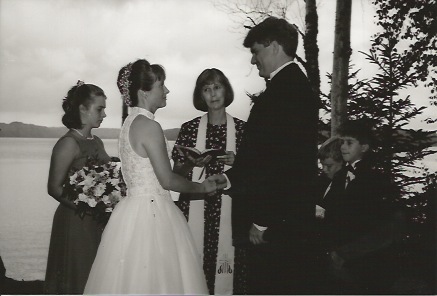
Sixteen years ago today, Kathy and I were married at a lovely spot in Michigan's Upper Peninsula. Her kids from a previous marriage made up our wedding party. I actually knew the kids before I knew Kathy (long story).

Before we were married, Kathy promised me that life with her and the kids would be an adventure. She wasn't kidding. It has been an amazing adventure. And whenever things got interesting, we would remind each other of that promise by humming the first few bars of the Indian Jones Theme Song.


I often tell this story to preservice teachers to prepare them for the adventure of teaching. And whenever one of the lessons I'm observing gets interesting, I might remind them of the promise that teaching is an adventure. Or I might begin singing: da da da daaaa, da da daaa, da da da daaaa da da daa daa daa...

Wednesday, July 17, 2013

Where were we?

or
Why teachers ought to use re-caps instead of warm-ups

With the exception of news and sports, I rarely watch live television. It is just so much more efficient to use our DVR to record a show and then fast-forward through the title footage and the commercials. There was a time when I also skipped the re-caps that started each show - until Lost.

What I came to see was that these re-caps offered more than a simple review of what had happened previously in the story. The information provided at the beginning of each episode was meant to prepare me with what I needed to know to understand what was going on. It highlighted certain points that I might have missed or dismissed as unimportant. At times, it also foreshadowed a plot point that would be uncovered in the episode; this helped me to see the story as connected (and gave me the feeling that I had solved some puzzle). In other words, it got me to engage at a deep level.

This is what I want to happen at the beginning of my lessons. Instead of spending time on a typical warm-up, I want to use a re-cap that highlights what is important and foreshadows what is coming up in the lesson. We know that learning is supported when it builds on prior knowledge and is seen as fitting into some larger structure (How Students Learn). In The Teaching Gap, there is a description of how a Japanese math teacher uses something similar at the beginning of a geometry lesson:
One lesson ... began with pure memorization. The teacher asked students to recite three properties they had learned already about parallelograms ... As it turned out, the three properties they had just memorized were the key pieces they needed in order to work out a proof. Most students were reasonably successful. (pp. 75-6)
As Hattie points out that, "Too often, students are asked to relate and extend with minimal ideas on which to base this task - leading to impoverished deeper learning. It is for this reason, the workshop model puts such attention on the Schema Activation phase of the lesson and why a traditional warm-up does not cut it.

If professional storytellers understand the importance of activating the schema of a viewer (just look at the number of shows that use re-caps in the video below), then why don't educators make better use of this approach?


Here is where I need your help. What would a re-cap look like in a lesson? Is it the First Act in the 3 Act framework (or perhaps Act 0)? Maybe it is student-work or video of students doing work collected previously that the current lesson will build on. Could it entail students developing a video at the end of a lesson synthesizing what had been done that could be shown during later lessons to provide a reminder of important information that relates to new content?

What do you think?

TEDxGrandValley